

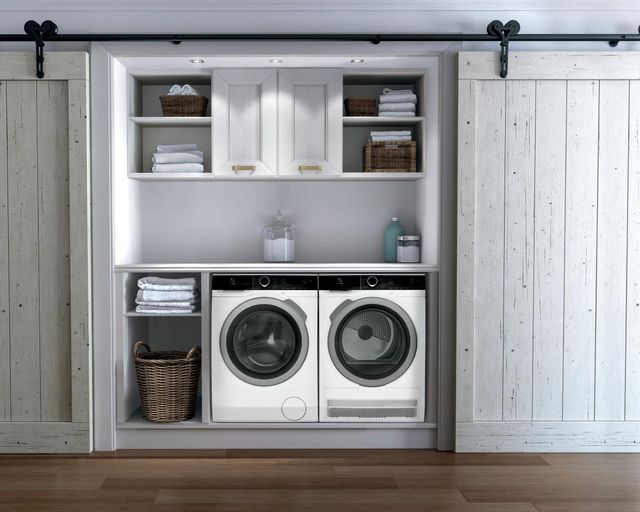
The tape measure says 30 inches across the laundry closet, and the bifold door eats a couple of those inches on each side when it folds back. The side-by-side pair that looked perfect in the showroom needs 54 inches of clear wall, so it was never going to land in a Phoenix condo hallway. Then there is the hookup box, sitting about 42 inches off the floor on the right-hand wall, exactly where a dryer vent elbow wants to live. That is the point where most shoppers start pricing a stackable washer and dryer, because going vertical turns a 30-inch closet into a working laundry room by using height instead of width.
Find the Laundry Pair That Fits Your Closet
Our team measures, matches, and stacks laundry pairs across the Valley every week, from 24-inch compact sets to full-size family pairs. Shop washers, dryers, stacking kits, and professional installation in one place.
Here is the part that takes the pressure off: the measuring is the hard half of this project, and it is fully solvable in an afternoon with a tape measure and a notepad. At Spencer’s TV & Appliance, our team helps Valley shoppers match real closet dimensions to a stackable washer and dryer that fits, stacks safely, and vents the way the space allows. This guide walks through what can and cannot be stacked, the exact measurements to take, compact 24-inch versus full-size 27-inch capacity, venting and fuel type, the features worth paying for, the honest trade-offs, and what a professional stacked installation actually involves.
Key Takeaways
- Only front load washers stack: Stacking requires a front-loading washer on the bottom and a compatible dryer bolted above it. Top load washers cannot be stacked because the lid opens upward.
- Stacked height is the number people forget: A full-size pair runs roughly 27 inches wide and 77 to 80 inches tall once stacked, so ceiling height, shelving, and soffits decide the purchase as much as width does.
- The stacking kit is model-specific: Manufacturer brackets and fasteners are matched to particular washer and dryer families, are usually sold separately, and keep warranty coverage intact.
- Venting drives your options: A ventless heat pump or condenser dryer removes the need for an exterior duct, which is often what makes an interior closet or a condo laundry work at all.
What Is a Stackable Washer and Dryer and Which Models Can Actually Stack
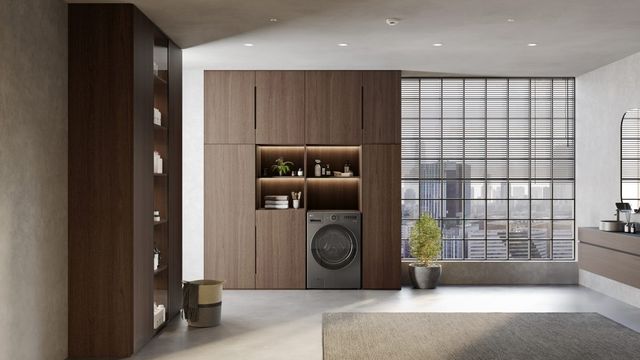
A stackable washer and dryer is two separate, fully functional appliances secured vertically with a manufacturer stacking kit, with the washer always on the bottom and the dryer above it. Each machine keeps its own controls, its own drum, and its own cycle list. The washer sits on the floor because it is heavier and because it holds water during a cycle, which makes it the stable base.
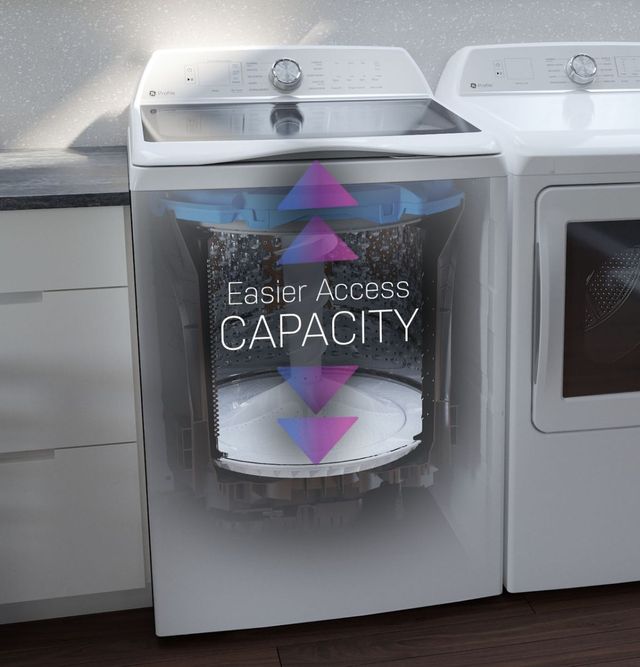
That vertical arrangement only works with a front load washer. A top load washer needs its lid to swing upward, and nothing can sit above it, which answers the question shoppers ask most often: no, not just any washer and dryer can be stacked.
Stackability is also model-specific rather than brand-wide. GE, LG, Samsung, Whirlpool, Electrolux, Maytag, and Bosch all build stackable front load laundry, but that does not mean any washer from a brand pairs with any dryer from that same brand. The two units generally need to share a width and a cabinet family, and the manufacturer publishes the approved kit number for the combination.
What a Stacking Kit Actually Includes
A stacking kit is not a strap and a prayer. Depending on the brand, the box contains:
- Steel brackets or a mounting frame that ties the dryer cabinet to the washer cabinet
- Model-specific fasteners, and on some kits, rubber isolation pads
- On certain compact kits, a pull-out shelf that gives you a folding surface between the two machines
- Printed instructions with the exact torque and placement the warranty depends on
Using the brand-specified kit matters for three reasons. It keeps the dryer from walking during a high-speed spin. It preserves warranty coverage on both appliances. And it manages vibration, which travels much further through a tall stack than through two machines sitting on the floor.
Stackable Pair, Laundry Center, All-in-One, or Single Cabinet
These four configurations get lumped together in search results, and they are not the same product.
- A stackable pair is two independent appliances. If the dryer fails in year nine, you replace the dryer, not the laundry room.
- A laundry center fuses a small washer and a small dryer into one welded cabinet, usually 70 to 76 inches tall, which is a real advantage under a low ceiling and a real limitation on capacity.
- An all-in-one washer dryer combo is a single machine that washes and then dries in the same drum, roughly 39 inches tall, with no second unit above it.
- A single-cabinet tower such as an LG WashTower is a factory-stacked pair with one shared control panel at chest height, which solves the reach problem but removes the ability to mix and match.
The ability to replace one appliance instead of both is the quiet advantage of a stackable pair, and it is the reason our team recommends the configuration for most laundry closets.
Read more:
How to Measure for a Stackable Washer and Dryer Before You Buy
Numbers first, shopping second. Full-size stackable pairs run about 27 inches wide, roughly 32 to 34 inches deep with the door closed, and 77 to 80 inches tall once stacked. Compact pairs run 24 inches wide, about 24 to 26 inches deep, and 68 to 72 inches tall stacked.
Those are appliance body dimensions. Your closet needs more than that.
- Add 4 to 6 inches behind the machines for fill hoses, the vent transition, and the power cord without crushing anything against the wall.
- Add about an inch on each side so the cabinets are not wedged and vibration is not transmitted straight into the framing.
- Add front clearance for a door that swings roughly 22 to 24 inches out, plus somewhere for a laundry basket to sit.
The Measurements Competitors Skip
Width gets all the attention. These are the ones that derail deliveries.
Ceiling height versus stacked height comes first. An 80-inch stack under a shelf at 74 inches does not fit, and a wire shelf is much cheaper to remove before delivery than after.
Control panel reach comes second. On a full-size stack, the dryer control panel typically lands between 68 and 76 inches off the floor, and the lint screen sits in that same zone. If the primary laundry user is 5 feet 2 inches, that panel is a daily stretch, and a step stool in a narrow closet is its own hazard.
Door swing comes third. Bifold doors reduce the usable opening by several inches on each side when folded, sliding doors block half the opening at all times, and a front load door hinged on the wrong side can hit the door frame before it opens far enough to load. Reversible washer doors solve this on some models, and asking about hinge side before you buy is far easier than living with it.
The delivery path comes fourth. A 27-inch wide appliance with a 34-inch depth has to clear every doorway, stair turn, and hallway corner between the truck and the closet.
Airflow and Closet Doors
An enclosed laundry closet needs make-up air. A gas dryer needs combustion air, and every dryer needs replacement air for what it pushes out the vent. Louvered or vented closet doors exist for exactly that reason, and building codes commonly require a specified free-air opening for gas installations. A solid door on a tight closet starves the dryer, stretches cycle times, and lets heat build around the electronics.
Your Tape Measure Checklist
- Measure the closet or alcove width at the floor, at 40 inches, and at the top, since walls are rarely square.
- Measure depth from the back wall to the face of the door frame, then note where the hookups and vent stub sit.
- Measure floor to ceiling, and floor to the bottom of any shelf, soffit, or cabinet.
- Measure the door opening width with the door in its open position, not the rough opening.
- Walk the delivery path and measure the narrowest doorway, the tightest stair turn, and any hallway corner.
- Note the outlet type, the gas shutoff if there is one, the drain standpipe height, and whether the floor is level.
Bring those six numbers to the showroom and the conversation goes from guessing to matching in about ten minutes.
Stackable Washer and Dryer vs Laundry Center vs All-in-One vs Side-by-Side
Read this table by finding your space constraint first, then the capacity you need, then the limitation you can live with. The right answer is usually the configuration whose limitation bothers you least.
| Configuration | Typical Footprint | Capacity Range | Best For | Key Limitation |
|---|---|---|---|---|
| Stackable Washer and Dryer Pair | 27 in wide, 77 to 80 in stacked | Washer 4.5 to 5.2 cu ft, dryer 7.0 to 7.8 cu ft | Laundry closets, second-floor laundry, busy families | Needs a front load washer and the correct stacking kit |
| Laundry Center | 24 to 27 in wide, 70 to 76 in tall | Washer 2.3 to 3.8 cu ft, dryer 4.0 to 5.9 cu ft | Low ceilings, casitas, rentals, garage corners | Fused cabinet, so one failure can sideline both halves |
| All-in-One Washer Dryer Combo | 27 in wide, about 39 in tall | 4.5 to 5.3 cu ft washing and drying in one drum | Tightest closets, condos, spaces with no duct | Long combined cycle times, one load at a time |
| Traditional Side-by-Side Pair | 54 in wide, about 39 in tall | Washer 4.5 to 6.0 cu ft, dryer 7.0 to 8.0 cu ft | Dedicated laundry rooms, garages with wall to spare | Wide footprint a closet cannot absorb |
For the most common scenario in Phoenix-area homes, a 27 to 30 inch laundry closet with standard 8-foot ceilings, the stackable pair wins on capacity per square foot and on long-term repair flexibility.
Compact 24-Inch or Full-Size 27-Inch: Choosing Capacity That Fits Your Household
Width and capacity travel together. Compact 24-inch washers commonly hold 2.2 to 2.6 cubic feet. Full-size 27-inch washers commonly hold 4.5 to 5.2 cubic feet. That difference is roughly double, and it shows up as loads per week rather than as a spec sheet abstraction.
A 2.4 cubic foot compact washer handles about 12 to 14 pounds of laundry, which is a normal week for one person and a tight but workable week for a couple. A 4.5 cubic foot full-size washer handles 18 to 20 pounds and swallows a full hamper plus towels in one pass. For a family of four washing school clothes, bath towels, bedding, and soccer gear, the compact pair means running the machine most nights instead of two or three times a week.
Household guidance breaks down cleanly:
- One or two people in a condo, apartment, or casita: a compact 24-inch pair is genuinely sufficient.
- A couple who entertains, travels, or has pets: full-size if the closet allows it, compact if it does not.
- Family of three or more: full-size, every time, because load count drives how much laundry day actually costs you.
- A second laundry area upstairs or in a guest suite: compact makes sense as the secondary machine.
Why Dryer Capacity Is Bigger Than Washer Capacity
Dryers are always rated larger than their matching washers, and that is by design rather than by marketing. Wet laundry compresses, and it needs room to tumble and open up so hot air can reach every surface. A 4.5 cubic foot washer normally pairs with a 7.0 to 7.4 cubic foot dryer.
That is also why mismatched pairs create bottlenecks. Put a big full-size washer load into an undersized dryer and you either split the load in two or run one long, inefficient cycle with damp spots in the middle. Matching within a manufacturer’s designated pair avoids the problem entirely.
Let the Bulkiest Item Set the Size
Family size is the usual advice, and it is incomplete. The single item that decides washer capacity is the bulkiest thing you wash at home.
A king comforter needs roughly 4.5 cubic feet to move freely. A queen comforter needs about 3.8. A large dog bed with a foam insert can be worse than either. If you wash a king comforter at home rather than dropping it off, that one item eliminates compact machines from your list regardless of how few people live in the house.
Also worth knowing: the largest-capacity front load washers add depth and height, and the deepest models may not leave room for the vent transition in a shallow closet. Capacity is only useful if it fits.
Venting, Fuel Type, and Hookups: The Requirements That Decide Your Options
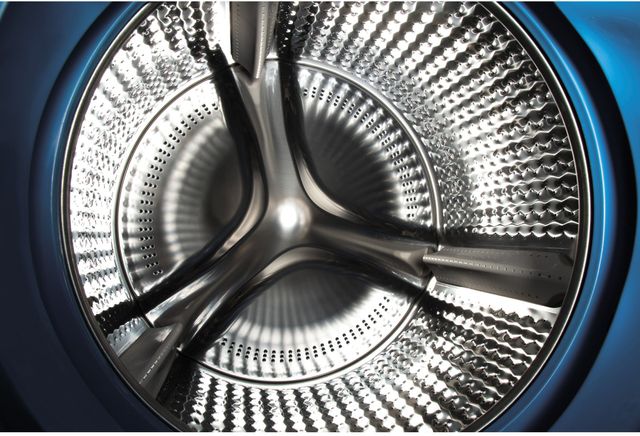
This section is where a lot of shopping lists get shorter, because the space decides what is possible.
Vented Versus Ventless Drying
A vented dryer heats air, pulls it through the drum, and pushes the moisture outside through a duct. It is fast, it is simple, and it requires an exterior duct run.
A ventless dryer keeps the air inside the machine. Condenser models cool the moist air to pull water out and send it down the drain. Heat pump models do the same thing with a refrigerant loop, which recycles heat instead of throwing it away and uses noticeably less energy.
Ventless drying is what makes interior closets, mid-building condos, and converted spaces work. If there is no path to an exterior wall, a ventless heat pump dryer or an all-in-one combo is often the only realistic option.
The trade-off is honest and worth stating plainly. Heat pump dryers are efficient and gentler on fabric because they dry at lower temperatures, and they take longer, frequently 30 to 60 percent longer than a comparable vented cycle. If a duct already exists and you value speed, vented electric or gas is still the faster choice.
Gas, 240-Volt Electric, or 120-Volt Compact
Fuel type is not a preference, it is an inventory of what is already in the wall.
- A gas dryer needs a gas line with a shutoff plus a standard 120-volt outlet for the controls and motor.
- Most full-size electric dryers need a dedicated 240-volt outlet on a 30-amp circuit.
- Many compact 24-inch dryers, including heat pump models, run on a standard 120-volt outlet, which is what makes them practical in apartments and retrofits where adding a 240-volt circuit means an electrician and drywall work.
Check the receptacle before anything else. A 3-prong and a 4-prong 240-volt outlet are not interchangeable without the correct cord, and cords are frequently sold separately from the dryer.
Water, Drain, and Leak Protection
The washer needs hot and cold supply valves and a drain. Drain standpipe height matters more than people expect, since a standpipe that is too low can siphon and a standpipe that is too high strains the pump. Most manufacturers specify a range in the 30 to 40 inch zone, and the installation manual gives the exact figure for the model.
For any second-floor or interior-closet stack, a drain pan under the washer and a simple leak sensor are cheap insurance. A leak in a garage runs across concrete. A leak in an upstairs hall closet finds the ceiling below it.
Phoenix Realities Nobody Else Mentions
Valley laundry rooms live a harder life than the national averages assume.
Garage and exterior-wall laundry areas routinely pass 110 degrees in July and August. Heat is hard on control boards and on the plastics in dispensers and hoses, and a heat pump dryer working against 110-degree intake air will run longer than its rated cycle. Shade, insulation, and a mini-split or a vent from the conditioned side of the house all help.
Hard water is the second factor. Valley tap water carries a lot of dissolved mineral, which means detergent works less effectively, dispensers develop scale, and front load gaskets collect residue faster. Using the right dose of high-efficiency detergent, rather than more of it, keeps suds from redepositing on fabric.
Dust and pollen are the third. Monsoon dust and construction dirt load a lint screen faster than the manual assumes, so a stacked pair in the Valley wants its screen cleaned every load and its vent inspected annually instead of every couple of years.
Finally, look at ENERGY STAR certification while you compare. Certified washers use significantly less water per load, and certified heat pump dryers use a fraction of the electricity of a conventional vented unit. Across a decade of loads, that shows up on both utility bills, which is worth real money in a market with long, hot summers.
Stackable Washer and Dryer Pros and Cons Worth Weighing
Stacking is a genuine space solution, not a compromise, but it is a layout decision with consequences. You gain floor area and you change how your body interacts with the machines every single load. Understanding both sides in advance keeps you from discovering the trade-off with an armful of wet towels.
Pros
Recovered floor space
Going vertical cuts a 54-inch laundry footprint to about 27 inches, which turns a closet, a hallway alcove, or a garage corner into a full laundry area.
Front load efficiency and gentler care
Front load washers use less water than a comparable top load, spin out more moisture so drying takes less time, and tumble clothes rather than dragging them across an agitator.
Replace one machine, not two
Because a stackable pair is two independent appliances, a failed dryer at year ten is one purchase and one installation instead of a full laundry replacement.
Wall space you can use
The 27 inches you free up often becomes a folding counter, a utility sink, a broom closet, or shelving, which is a bigger quality-of-life gain than the square footage suggests.
Fits homes where nothing else does
Condos, casitas, second-floor laundry closets, and older Phoenix homes with narrow utility spaces are exactly the situations a stack was designed for.
Cons
Reaching the dryer controls and lint screen
On a full-size stack, the dryer panel sits 68 to 76 inches off the floor, so shorter users are stretching for controls and for the lint screen every load.
Accessibility limits
Loading a dryer at chest or shoulder height is difficult for anyone with a shoulder injury, limited mobility, or balance concerns, and a step stool inside a narrow closet adds its own risk.
Vibration travels further
A tall, heavy stack on a suspended second-floor deck transmits spin vibration into the framing more readily than two machines on the floor, so noise control features matter more here than in a garage.
Read more:
Features to Look for in a Stackable Washer and Dryer
Feature lists run long. Grouping them by what they do makes it easier to decide where the money goes.
Cleaning and Fabric Care
Steam cycles inject steam into the drum to loosen soil and relax wrinkles, and on a dryer they refresh clothes that have been sitting in a hamper. Sanitize cycles hold a high water temperature long enough to reduce bacteria, which matters for bedding, towels, and anyone in the house with allergies. Allergen cycles combine hot water with extra rinses to flush out dust and pollen residue, which is genuinely useful in the Valley during spring and monsoon season. Stain-specific programs pre-treat by soil type instead of running one generic heavy-duty cycle.
Worth paying for: steam on the washer, sanitize, and extra rinse options. Skip if the budget is tight: dozens of niche stain programs you will never scroll to.
Convenience and Control
These features earn their keep specifically because a stacked pair usually lives behind a closed door.
- Reversible doors, so the hinge side can be flipped to work with a tight closet opening
- Interior drum lights, which matter when the closet has no fixture of its own
- Delayed start, so a cycle can end when you are home rather than eight hours earlier
- Cycle memory, which saves you from re-selecting the same settings every time
- Automatic detergent dispensers that hold weeks of detergent and dose per load, useful with hard water
- Smart app monitoring and cycle-complete alerts, so you know the load finished without opening the closet
Worth paying for: reversible doors when the closet is tight, delayed start, and cycle-complete alerts. Marketing extra: app-based cycle downloads that add specialty programs you are unlikely to use.
Noise and Vibration Engineering
In a stack, the dryer sits at eye level and the washer transmits every spin into the cabinet above it. Direct drive motors remove the belt and pulley, which cuts both noise and maintenance. Vibration reduction systems combine drum balancing, counterweights, and better suspension to keep a high-speed spin from shaking the stack. Quiet operation ratings and cycle sound ratings give you a comparison point between models.
This is not a luxury category when the laundry closet shares a wall with a bedroom, a nursery, or a living room. It is the feature group most worth the upcharge in a stacked configuration.
Dryer Sensing and Fabric Protection
Moisture sensor drying reads how wet the load is and stops when the clothes are dry, instead of running a fixed timer. That protects fabric, saves energy, and prevents the over-dried, static-heavy result a timed cycle produces. Wrinkle prevent tumbles periodically after the cycle ends so a forgotten load does not set into creases. A drying rack accessory holds sneakers, sweaters, and delicates still while warm air moves around them.
Worth paying for: moisture sensing, without question. Nice to have: wrinkle prevent. Optional: the drying rack, unless you actually wash wool or wash athletic shoes often.
Stacking Kits, Installation, and Long-Term Care
A stacked pair is a load-bearing assembly holding a machine that spins at 1,200 RPM. The installation deserves attention.
The sequence matters. The correct model-specific stacking kit goes on first, the floor gets checked for level, and the washer gets leveled on all four feet before the dryer ever comes off the dolly. A washer that rocks even slightly at floor level will amplify that motion four feet higher. Brackets get secured per the instructions, then the vent and hoses get routed behind the stack without kinks, crimps, or crushed corners.
Professional installation matters more for a stacked pair than for almost any other appliance. A full-size dryer weighs 120 to 140 pounds and has to be lifted above waist height into a confined closet. Some installations require anchoring to wall framing. Vent transitions have length limits. Gas connections need a leak check. And manufacturer warranty terms often reference proper installation with an approved kit.
Here is the detail our installers plan around on closet jobs: manufacturers typically rate a 4-inch rigid metal dryer duct for about 35 feet of total developed length, and every 90-degree elbow subtracts roughly 5 feet from that budget. A closet stack with three turns between the dryer and the exterior wall is effectively working with 20 feet, which is why the flexible transition piece behind the machine needs to be as short and straight as the space allows.
Do not improvise a stack. Generic straps, wood platforms, shims, and stacking two machines that were never designed to pair are how dryers come off washers. Incompatible stacking risks damage to both units, personal injury, and voided coverage, and no amount of careful work makes an unapproved combination safe.
Care after installation is short and repeatable:
- Wipe the front load door gasket and leave the door ajar between loads so it dries out.
- Rinse the detergent and softener dispensers monthly, more often with hard water.
- Clean the lint screen every single load, which matters more here given Valley dust.
- Run the drum-cleaning cycle monthly to keep odor and residue from building up.
- Have the vent inspected and cleaned annually.
- Recheck level if the stack ever starts to walk or the spin gets loud.
At Spencer’s TV & Appliance, delivery, professional installation, stacking kit fitment, and haul-away of your old pair are handled by our own teams, and local service is available after the sale. Our showroom staff will also confirm stack compatibility and closet clearances with you before you buy, which is far less painful than discovering a fit problem on delivery day.
What a Vented Stacked Dryer Costs You in a Phoenix Summer
A vented dryer is essentially an air pump with a heater attached. It pulls conditioned air out of your house, runs it through the drum, and throws it outside along with the moisture, typically moving somewhere between 150 and 200 cubic feet per minute while it runs. That air has to be replaced, and in a house sealed against a 112-degree afternoon, it gets replaced by hot outside air leaking in through the attic hatch, recessed lights, and door frames. Every drying hour quietly pulls outdoor heat into a space your air conditioner just paid to cool, and a family running eight loads a week in July is doing that for roughly six hours. It is the least discussed operating cost in laundry, and it changes how a Valley shopper should weigh vented against ventless.
- A ventless heat pump dryer exhausts nothing outdoors, so it neither depressurizes the house nor pulls in replacement air, and it recycles its own heat between cycles.
- The trade is cycle length and interior heat: a ventless dryer releases some warmth into the room it sits in, which is fine in a hallway closet and less fine in a small, closed, unconditioned space.
- A garage stack sidesteps the depressurization issue entirely, since the garage is not conditioned, but it exposes the machines to summer temperatures that shorten control board life.
- Louvered closet doors and a make-up air opening reduce the pressure imbalance a vented dryer creates and keep cycle times from stretching.
- Bigger washer capacity cuts total dryer runtime more effectively than any efficiency setting, because fewer, fuller loads mean fewer hours of exhaust.
- Running loads in the evening shifts both the dryer heat and the replacement air load away from peak afternoon cooling demand.
Read more:
- The Perfect Stackable Washer and Dryers for Apartment Living
- Get Familiar with Each Best Washer and Dryer Brand
Top Stackable Washer and Dryer Sets at Spencer’s TV & Appliance
The lineup below covers the realistic paths through this decision: a full-size stackable pair for a family laundry closet, a 24-inch compact washer for a condo or casita, two all-in-one combos for closets too short to stack anything, a front load washer to build a value stack around, and one top load option for shoppers who find they had the floor space after all. Every model can be seen in person in a Spencer’s showroom before it goes into your closet.
GE White Front Load Washer Electric Dryer Laundry Pair
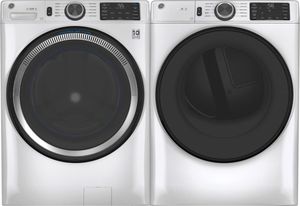
This is the straightforward answer for a household that needs full-size capacity inside a standard laundry closet. The front load washer and matching electric dryer are designed to stack with GE’s bracket kit, which keeps the pair inside roughly 27 inches of width instead of the 54 inches a side-by-side demands. The electric dryer expects a dedicated 240-volt outlet, so confirm that circuit before delivery day. Buying the units as a matched pair also avoids the capacity bottleneck described earlier. Spencer’s delivers, stacks, levels, and hauls away the old set in a single visit.
Top Features
- Designed to stack: Front load washer and matching dryer accept the GE stacking kit for a 27-inch footprint.
- Full-size capacity: Handles towels, bedding, and family-sized loads without splitting them in two.
- Matched washer and dryer sizing: The dryer drum is sized for full washer loads, so nothing runs half dry.
- Electric operation: Plugs into a standard dedicated 240-volt laundry circuit found in most Valley homes.
Electrolux 2.4 Cu. Ft. Compact Stackable White Front Load Washer

Condos, casitas, and hallway closets measuring 25 inches across are where this compact washer earns its spot. At 24 inches wide with a 2.4 cubic foot drum, it covers roughly two to three loads a week for one or two people, and it is built from the start to stack beneath a matching compact Electrolux dryer using the brand stacking kit. Compact dryers in this class frequently run on a standard 120-volt outlet, which makes a retrofit far simpler. Our team can verify stacked height against your closet opening before you order.
Top Features
- True 24-inch width: Fits narrow closets and alcoves where a 27-inch machine will never go.
- Stack-ready design: Pairs with a matching compact Electrolux dryer and the approved stacking kit.
- 2.4 cubic foot capacity: Right-sized for one or two people without wasting water on partial loads.
- Shallow depth: Leaves room behind the machine for hoses and a vent transition in a tight closet.
LG 5.0 Cu. Ft. Black Steel Washer Dryer Combo
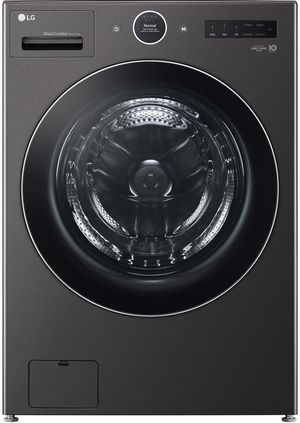
When the closet is too short to stack anything, a single machine that washes and then dries is the way out. This all-in-one combo holds 5.0 cubic feet, enough for a king comforter, and it dries with a ventless heat pump, which removes the exterior duct and the vent elbow that fights the hookup box. Expect a longer combined cycle in exchange for loading once and walking away. The black steel finish suits laundry areas that double as a mudroom. See it run in a Spencer’s showroom before committing.
Top Features
- Washes and dries in one drum: No second unit above it, so a 39-inch-tall space is enough.
- Ventless heat pump drying: Works in interior closets and condos with no path to an exterior wall.
- 5.0 cubic foot capacity: Large enough for bedding and bulky items despite the single-unit format.
- Black steel finish: Holds up visually in mudrooms and multipurpose laundry spaces.
GE Profile 5.4 Cu. Ft. White Impeller Top Load Washer with Smarter Wash Technology and FlexDispense
Some shoppers measure the alcove and discover they had the floor space all along. Top load washers do not stack under any circumstance, because the lid has to open upward, so this is the side-by-side path rather than the vertical one. What you get in return is a 5.4 cubic foot impeller drum, deep-fill flexibility for heavily soiled loads, and a loading height that never asks you to reach above your shoulders. Smarter Wash Technology adapts the cycle to the load. Spencer’s installers handle hookups and haul-away.
Top Features
- 5.4 cubic foot impeller drum: Large capacity with no center agitator taking up drum space.
- Smarter Wash Technology: Adjusts cycle settings based on load size and soil level.
- FlexDispense system: Holds detergent for multiple loads and doses automatically.
- Comfortable loading height: Nothing sits overhead, which suits anyone avoiding a raised dryer panel.
Samsung Bespoke 5.3 Cu. Ft. Dark Steel Washer Dryer Combo
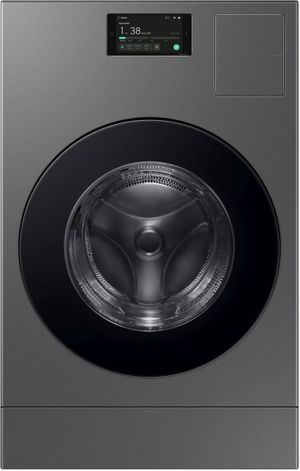
This is the premium single-unit alternative to a stack, built for shoppers who want one machine, quiet operation, and steam care in a space that cannot take two. The 5.3 cubic foot drum washes and then dries in the same basket with ventless heat pump drying, so an interior closet with no duct run stops being a dead end. Smart cycle selection and app monitoring matter more than usual here, because a combo runs long and a phone alert beats standing at the closet door. Local Spencer’s service backs it after the sale.
Top Features
- One machine, both jobs: Load once, walk away, and skip the transfer step entirely.
- Ventless heat pump drying: Gentle, efficient drying with no exterior duct required.
- 5.3 cubic foot capacity: Handles comforters and full hampers in a single-unit footprint.
- Smart monitoring and alerts: Cycle-complete notifications keep long combo cycles from being forgotten.
- Dark steel finish: A premium look for laundry areas that are visible from living space.
Whirlpool 4.5 Cu. Ft. White Front Load Washer
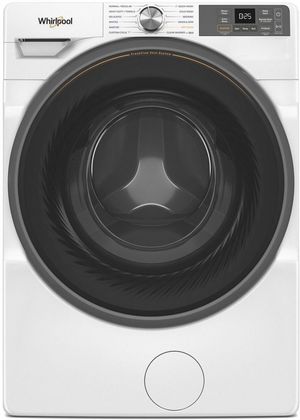
For a value-focused stack in a standard laundry closet, this front load washer is the foundation to build on. The 4.5 cubic foot drum covers towels, bedding, and a family week of laundry, and it accepts a Whirlpool stacking kit so a matching dryer can sit directly above it. Front load design is the reason the stack is possible at all, as covered earlier in this guide. Load-and-go dispensing cuts down on detergent trips. Ask our laundry specialists which Whirlpool dryer is the approved stacking partner for this exact model.
Top Features
- 4.5 cubic foot capacity: Enough room for a queen comforter and full family loads.
- Stack-compatible front load design: Accepts a Whirlpool stacking kit with a matching dryer on top.
- Load-and-go dispenser: Holds detergent for multiple loads so you skip the measuring step.
- Strong spin extraction: Removes more water in the washer, which shortens every drying cycle.
Your Stackable Washer and Dryer Decision Made Simple
Confirm that the two machines are an approved stacking combination and buy the correct kit, then measure width, depth, stacked height, and door swing before anything gets ordered. From there, pick the capacity your bulkiest load requires and the venting and fuel type your space can genuinely support, and the rest of the decision falls into place. Those three steps are the whole project.
Ready to compare them side by side? Shop stackable laundry pairs at Spencer’s TV & Appliance online or visit any of our Phoenix-area showrooms. Our laundry specialists will check your closet numbers and stacking kit compatibility with you before you spend a dollar, our own crews handle delivery, professional installation, and haul-away, and our service department is local when you need it years from now. That is the difference between buying from an independent retailer in your own metro and clicking a button at a warehouse.
Frequently Asked Questions about Stackable Washers and Dryers
Only front load washers can be stacked, and they must be paired with a compatible dryer from the same brand and cabinet family using that manufacturer’s stacking kit. Top load washers cannot be stacked because the lid opens upward, and mismatched brands or widths leave the kit brackets nothing to bolt to.
A full-size stackable washer and dryer needs roughly 28 inches of width, 34 to 37 inches of depth including hoses and vent, and 78 to 82 inches of vertical clearance. Compact 24-inch pairs reduce that to about 25 inches wide and 68 to 72 inches tall, which is what lets them fit beneath a shelf or a low soffit.
Yes, a manufacturer stacking kit is required for nearly every stackable washer and dryer, and it is almost always sold separately. The brackets tie the two cabinets together so spin vibration cannot walk the dryer off the washer, and skipping the kit can void warranty coverage on both machines.
A stackable pair is usually the better choice because it offers the most capacity and lets you replace one appliance instead of two. A laundry center makes more sense under a low ceiling, and an all-in-one combo wins when the space is too short to stack anything at all.
Most stackable washer and dryer pairs run about 1,600 to 3,200 dollars for both machines, with premium steam and smart models going higher, plus roughly 40 to 60 dollars for the stacking kit. Delivery, stacked installation, and haul-away are quoted separately, and Spencer’s TV & Appliance can bundle those services into the purchase.
Stacked laundry pairs are as reliable as their side-by-side equivalents and typically last 10 to 13 years with routine care. Stacking does not shorten appliance life by itself, though a stack that is not level or not bracketed correctly puts added stress on the washer suspension.
Why Trust Spencers TV & Appliance?
Since 1973, Spencer’s TV & Appliance has grown to 11 locations throughout the Phoenix Metropolitan Area. The secret to our longevity is simple: personal service. Customer satisfaction has always been the focus of our business, and throughout the years, we have been able to work hard with our suppliers to bring you the best prices. After all, getting customers the best price and personal attention is how we compete with big-box stores, day in and day out.
Not only do we offer top-rated appliances, name-brand electronics, and the best mattresses on the market but we also provide water treatment solutions and perform kitchen design services. Stop by your nearest Spencer’s and see what you’re missing!
Shop Stackable Washer and Dryers at Spencers
At Spencers TV & Appliance, we provide high-quality, name-brand products at great prices. Your friends in the business are always happy to help you choose the best mattress for lower back and leg pain. Call us, or better yet, stop by at one of our locations in the Phoenix, Scottsdale, and Glendale regions. Visit us today!