
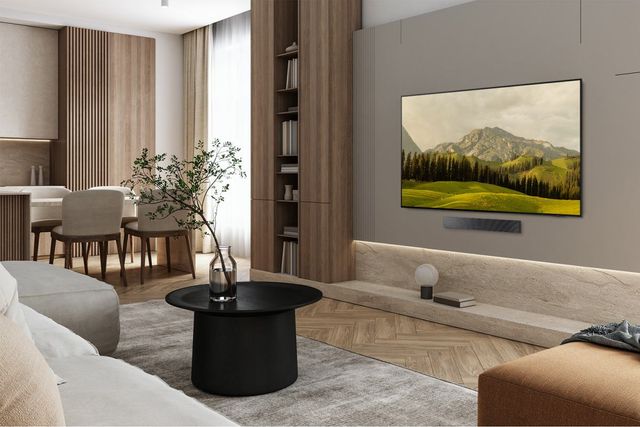
The mount goes on the wall Saturday morning, the box comes off the new set that afternoon, and by movie night the family is settled on the sectional staring at a screen that reads smaller in the room than it ever did on the sales floor. The tape measure is still lying on the coffee table where it got abandoned halfway through the project. Somewhere between the wall studs and the checkout page, the wrong number got picked, and that is the moment most people finally sit down and work out what size TV do I need before ordering rather than after.
Find the Screen Size That Fits Your Room Perfectly
Spencers TV & Appliance has been helping Phoenix-area families match screen size to seating distance, room light and wall space since 1973. Compare sizes side by side in our showrooms, then let our own teams handle delivery, wall mounting and setup.
Explore what size tv do i needThe good news is that screen size is one of the easiest decisions to get right once the math is in front of you, because it comes down to three measurements anyone can take in ten minutes. At Spencers TV & Appliance, our team sizes screens for Valley homes every day, from small Tempe condos to two-story great rooms in Gilbert and Peoria with west-facing glass. This guide walks through how televisions are actually measured, the viewing distance formula that drives the whole decision, room-by-room sizing, how resolution and panel type change the answer, wall and furniture fit, the mistakes that cause returns, and a side-by-side chart of the most popular screen sizes.
Key Takeaways
Seating distance decides the size: Measure from the front of your seating to the wall in inches, then divide by 1.5 to 2.5 to get a comfortable screen size range.
Class size is not the full footprint: A 65 inch TV measures about 56.5 inches wide and 32 inches tall on the panel alone, and the bezel, feet and ventilation clearance all add to that.
- 4K changed the old rules: Higher pixel density lets you sit closer to a big screen without seeing pixel structure, so charts written for 1080p recommend screens that are now too small.
- Panel quality beats raw inches: A brighter, better panel one size down usually looks better in a sunlit Arizona room than a larger screen from a lower tier.
How TV Screen Size Is Actually Measured
Every screen size on a spec sheet is a diagonal measurement taken across the active display area, corner to corner. It is not the width of the cabinet, it does not include the bezel or frame, and it has nothing to do with the stand. That single fact explains most of the surprise people feel when a box arrives and the television is wider than the space they had planned.
Because televisions use a 16:9 aspect ratio, the diagonal locks the width and height into a fixed relationship. That relationship gives you a conversion habit worth memorizing: multiply the diagonal by roughly 0.87 for the panel width and by roughly 0.49 for the panel height. A 65 inch set works out to about 56.5 inches wide and 32 inches tall. A 75 inch set lands near 65.5 by 37 inches. With those two multipliers you can size any screen on any spec sheet without hunting for a chart.
Why a 65 Inch TV Is Not Exactly 65 Inches
Manufacturers publish a class size, which is a rounded category rather than a literal measurement. A television sold as a 65 inch class model often measures 64.5 inches diagonally, and a 55 inch class model may measure 54.6 inches. The rounding is standard across the industry and is disclosed in the fine print on the spec sheet. It rarely matters for viewing, but it matters when you are fitting a screen into a cabinet opening with an inch to spare.
Total width always exceeds the panel width once the bezel and cabinet are counted, and the stand footprint adds another variable. Some brands place feet at the outer edges of the cabinet, which means your media console has to be nearly as wide as the television itself. Others use a center pedestal that will sit on a much narrower surface.
Measuring Your Space the Right Way
Take three numbers before you shop, and write them down rather than trusting memory:
- Wall width available, measured between whatever bounds the space, such as a window casing, a corner or a doorway trim.
- Wall height available, from the top of the console or mantel to the ceiling or any soffit.
- Console width and depth, including the depth needed for the stand feet and for airflow behind the panel.
Leave a few inches of clearance around the set for ventilation and for a balanced look. A screen that fills a wall corner to corner reads cramped in person even when the numbers technically work.
The Viewing Distance Formula That Determines Your Ideal TV Size

Here is the short answer to the sizing question, and it is a calculation rather than an opinion. Measure the distance in inches from the front edge of your primary seating to the wall where the screen will hang, then divide that number by 1.5 to 2.5. The result is your comfortable screen size range in inches, with the lower divisor giving the more immersive end and the higher divisor giving the more relaxed end.
A sofa sitting 108 inches from the wall, which is nine feet, produces a range of roughly 43 to 72 inches. That means a 65 inch screen sits comfortably inside the range and a 75 inch screen is only slightly aggressive. Measure in inches from the start, because converting from feet at the end is where arithmetic errors creep in.
Read more:
Compare TVs: QLED, OLED, UHD & More
THX, SMPTE and What Viewing Angle Actually Means
Two industry recommendations sit behind those divisors, and both describe viewing angle rather than a fixed multiplier. THX targets roughly a 40 degree horizontal field of view, which is the cinematic end where the screen fills enough of your vision that you stop noticing the room. SMPTE targets roughly 30 degrees, which is a more relaxed reference commonly used for mixed viewing that includes news, sports and casual television.
In plain terms, a wider angle feels like a theater and a narrower angle feels like a living room. Neither is wrong. Households that mostly watch films and play games lean toward the THX end, and households where the television runs during dinner and homework lean toward SMPTE.
How Far Should You Sit From a 65 Inch TV
Applying the formula to a 65 inch screen gives a comfortable range of roughly 8 to 13.5 feet, with about 8 feet delivering the immersive THX-style angle and 13.5 feet delivering the relaxed end. Most Valley living rooms put the primary sofa somewhere between 9 and 12 feet from the media wall, which is precisely why 65 inches has become the default size in this market.
Resolution is the reason those numbers moved. At 1080p, sitting close enough for a 40 degree angle on a large screen meant seeing pixel structure in bright scenes. 4K UHD packs four times the pixels into the same panel area, so the picture holds together at distances that older charts flagged as too close. Any sizing guidance written before 4K became standard will steer you a size or two too small.
Almost everyone underestimates, and there is a cheap fix. Cut a rectangle of painters tape on the wall at the panel dimensions for the size you are considering, live with it for two days, and see whether it still looks big on Tuesday evening. Nine times out of ten the tape outline that looked enormous on Saturday looks about right by midweek.
Best TV Size for Every Room in Your Home
The formula gives a range. The room tells you where inside that range to land, because the variable that matters most changes from space to space.
- Living room: Seating typically 9 to 12 feet out, which supports 65 to 75 inches. Ambient light from windows usually matters more here than a few extra inches.
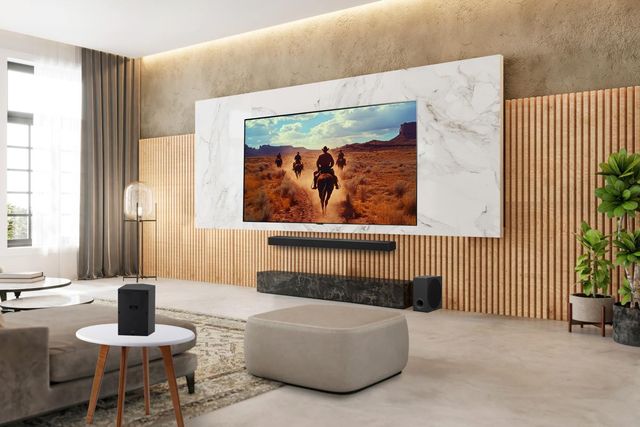
- Family room or great room: Seating 11 to 15 feet with a wide sectional, which supports 75 to 85 inches. Off-angle viewing quality becomes the deciding spec once seats spread out.
- Bedroom: Seating 6 to 10 feet from the foot of the bed, which supports 43 to 55 inches. Mounting height matters more than size, since you are reclined rather than upright.
- Kitchen: Viewing 5 to 8 feet from a standing or counter position, which supports 32 to 43 inches. Sight lines around cabinets and the range hood drive placement.
- Home office: Viewing 4 to 7 feet, which supports 43 to 50 inches when the screen doubles as a monitor. Text clarity at close range matters more than immersion.
- Basement or media room: Seating 12 to 18 feet in a controlled-light space, which supports 85 inches and up, or a projection setup where the room allows a longer throw.
- Covered patio: A distinct category entirely, where outdoor-rated brightness and weather sealing come before size.
Sizing for the Primary Seat, Not the Farthest One
Open concept floor plans are the norm in newer Phoenix-area homes, and they complicate the math because seating distance is not a single number. A great room might have a sofa at 11 feet, counter stools at 20 feet and a dining table at 24 feet. Size for the primary seat, meaning the place where the household actually watches a full movie, and treat the farther positions as casual viewing that does not need an ideal angle.
Mounting Height and the Fireplace Problem
The center of the screen should sit near seated eye level, which lands around 42 inches from the floor for most sofas. Getting that right does more for viewing comfort than one size step in either direction.
Over-fireplace mounting breaks that guideline, and it is common in Valley homes where the fireplace anchors the main wall. Pushing a screen up to 60 or 70 inches of center height forces your neck into a sustained upward angle and washes out contrast on many panels. If the fireplace wall is the only option, a tilting mount is not optional, and going one size smaller often reads better than going larger on a high mount.
Resolution, Viewing Angle and Room Light: The Factors Beyond Size
Size sets the frame. Everything else decides whether the picture inside it looks good. 4K UHD is the practical standard at 55 inches and above and there is no reason to shop below it at those sizes. 8K adds pixel density that pays off mainly on very large screens viewed at close range, and 1080p now belongs to small secondary screens in kitchens and workshops.
Pixel density is the concept tying resolution to size. The same 4K pixel count spread across an 85 inch panel puts those pixels farther apart than it does on a 55 inch panel, which is exactly why seating distance, not resolution alone, decides how large you can comfortably go.
Panel Technology and Arizona Light
Panel type matters more here than in most of the country, because Valley homes are built to bring in light and the sun is relentless from March through October. Brands like Samsung, LG, Sony and Hisense each cover several panel technologies, so the tier matters more than the badge.
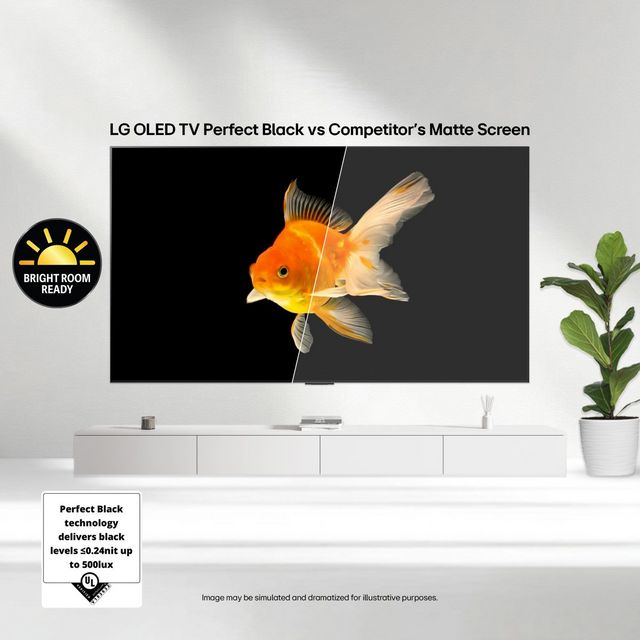
OLED: Perfect black levels, excellent off-angle viewing for wide sectionals, and the best contrast in a room where you can control light.
QLED and Mini LED: Much higher peak brightness, which is what beats daytime glare in a room with large west-facing windows.
- Standard LED: The value tier, where brightness and off-angle performance both fall off noticeably.
Here is the trade-off almost nobody states plainly: going one size larger in a lower panel tier usually looks worse than going one size smaller in a better tier. Poor off-angle performance on a big screen means half your sectional gets a washed-out picture, and low brightness on a big screen in a sunlit room means you close the blinds every afternoon.
Gaming shifts the calculation again. Console and PC gamers sit closer than movie watchers and care about refresh rate and input lag, so a 65 inch screen at 7 feet with a 120Hz panel usually beats a 77 inch screen at the same distance with a slower one.
TV Size Comparison Chart by Room, Distance and Dimensions
| Screen Size | Panel Width | Panel Height | Viewing Distance | Best-Fit Room | Min. Wall Width |
|---|---|---|---|---|---|
| 43 inch | About 37 in. | About 21 in. | 5.5 to 9 ft | Bedroom or office | 4 ft |
| 50 inch | About 43.5 in. | About 24.5 in. | 6.5 to 10.5 ft | Small living room | 4.5 ft |
| 55 inch | About 48 in. | About 27 in. | 7 to 11.5 ft | Condo or apartment living room | 5 ft |
| 65 inch | About 56.5 in. | About 32 in. | 8 to 13.5 ft | Standard living room | 6 ft |
| 75 inch | About 65.5 in. | About 37 in. | 9.5 to 15.5 ft | Family room or great room | 7 ft |
| 85 inch | About 74 in. | About 42 in. | 10.5 to 17.5 ft | Large open great room | 8 ft |
| 98 inch | About 85 in. | About 48 in. | 12 to 20 ft | Dedicated media room | 9 ft |
Read the chart by finding your measured seating distance in the fourth column first, then reading left to the size that matches. The 65 versus 75 inch decision is where most shoppers stall, and the tiebreaker is usually seating distance combined with wall width: at 10 feet or more with seven feet of clear wall, 75 inches is the better buy, while tighter rooms and shorter walls are better served by 65 inches and a stronger panel.
Wall Space, Furniture Fit and Mounting Considerations
A screen that suits your seating distance still has to physically fit, and this is where returns get generated. Start with the wall, then the furniture, then the hardware.
Console width is the first constraint. If the television uses feet placed at the outer edges of the cabinet, the console needs to be nearly as wide as the full cabinet, not the panel. A center pedestal design frees you to use a narrower console, which is why the stand style is worth checking on the spec sheet before you fall for a size.
Wall Mounting Realities
VESA is the standardized bolt pattern on the back of the television, expressed in millimeters, and the mount you buy has to match both that pattern and the weight of the set. Large screens are not light, and the mount rating needs headroom above the actual panel weight rather than sitting right at the limit.
- Locate studs and mount into them, never into drywall anchors alone at these sizes.
- Plan for a two-person install on anything 65 inches and larger.
- Decide on in-wall power and cable routing before the mount goes up, not after.
- Leave clearance below the screen for a soundbar so it does not block the bottom of the picture or the IR receiver.
- Check door swings and walkways so a wall-mounted screen does not sit in a traffic path.
Many Valley homes are block or masonry construction on exterior walls, which changes the anchoring hardware completely and is worth confirming before mounting day. Our team can walk through professional installation options for oversized screens and unusual walls.
Five Measurements to Take Before You Shop
- Distance in inches from the front of your primary seating to the mounting wall.
- Clear wall width between obstructions.
- Wall height from console or mantel surface to ceiling or soffit.
- Console width and depth, including stand footprint clearance.
- Delivery path width, meaning the narrowest doorway, stairwell turn or gate the box has to clear.
Common TV Sizing Mistakes and How to Avoid Them
Most sizing regret traces back to a handful of repeatable errors, and every one of them is avoidable with a tape measure and ten minutes.
- Trusting the showroom impression: A 75 inch screen looks modest under a warehouse ceiling and reads considerably larger against a standard eight foot ceiling at home.
- Measuring in feet: Rounding to the nearest foot introduces up to a full size step of error once the division is done.
- Forgetting the stand footprint: The panel fits the console and the feet do not, which is discovered on delivery day.
- Ignoring seated eye level: A perfectly sized screen mounted too high is uncomfortable to watch for two hours.
- Choosing size over panel quality: Inches are the cheapest spec to add, which is why entry-tier big screens are so heavily promoted.
Can a TV Be Too Big for a Room?
It can, but not for the reason most people assume. A screen becomes too big when your seating distance divided by the diagonal drops below about 1.2, because at that point your eyes have to track across the screen to follow action and the viewing angle causes fatigue on long content. The wall it hangs on is almost never the real limit. The distance from the sofa is.
Verify Before You Order
Delivery friction on oversized screens is real, and returning an 85 inch television is far harder than returning a 55. Before you order, confirm the shipping box dimensions rather than the television dimensions, then walk the delivery path from the front door to the media wall, including any stairwell turn, gate width or courtyard entry. Many Valley homes have a narrow side gate or a tight casita hallway that will not clear a large box even though the room beyond it is enormous.
What Size TV Do I Need: Pros and Cons of Going Bigger
Most shoppers regret going too small far more often than they regret going too large, but bigger is not automatically better. The trade-offs come down to seating distance, room light and how much of the budget goes to inches versus picture quality.
Pros
Better immersion at the same seat
Moving up one size widens the viewing angle toward the cinematic end without moving a single piece of furniture.
More of the 4K detail you paid for
Fine detail in a 4K signal becomes visible rather than theoretical once the screen is large enough at your distance.
Everyone on the sectional gets a real seat
Wide seating arrangements benefit most, since the outer positions stop feeling like the bad seats.
Better value per inch at larger sizes
Price per diagonal inch generally improves as sizes climb, so a step up often costs less than expected.
Cons
Discomfort when the distance is too short
Seating closer than roughly 1.2 times the diagonal causes eye tracking fatigue and can reveal pixel structure on lower-resolution sources.
Physical constraints multiply
Wall width, mount weight rating, stud spacing and the delivery path all become harder problems with every size step.
Sizing a TV for an Arizona Room the Sun Actually Reaches
Valley homes present a sizing problem that national buying guides never address, because they are designed around light and heat that most of the country does not have. Newer Phoenix-area construction favors two-story great rooms, tall west-facing windows and open sight lines from the kitchen to the media wall, which means a screen here often fights direct afternoon sun for six months of the year and sits in a room with two very different seating distances. Sizing purely by the distance formula in that room produces a screen that looks correct at night and washes out at 4 p.m. in June. The practical answer is to treat brightness as part of the size decision, not a separate one, and to measure the room at the hour you actually watch it. Here is the measurement habit our team recommends: take your seating distance reading twice, once in the evening with the lamps on and once at the sunniest part of the afternoon, and note whether you can read a newspaper by window light alone in the second reading. If you can, brightness tier outranks one size step.
- West and southwest-facing great rooms in Gilbert, Chandler, Queen Creek and Peoria need high peak brightness before they need extra inches, which points toward QLED or Mini LED over entry LED at any size.
- Two-story great rooms tempt shoppers into mounting high on a tall wall, so bring the center of the screen back down toward seated eye level even if the wall looks empty above it.
- Older Phoenix, Scottsdale and Tempe homes with eight foot ceilings and block exterior walls need masonry anchors and often make 65 inches the practical ceiling on a shared wall.
- Covered patios and outdoor kitchens are common here and require outdoor-rated sets, since summer heat and monsoon dust will end an indoor television quickly.
- Snowbird casitas and guest suites usually get a 43 to 55 inch screen, since the seating distance in those rooms rarely exceeds nine feet.
- Rooms with a fireplace or a media niche framed in stone should be measured at the niche opening, since builders size those openings for the screens that were common when the house was built.
Read more:
What is the Best TV for Gaming?
Outdoor TV Buying Guide: What to Know Before You Install
Top TV Sizes and Models Available at Spencers TV & Appliance
The sets below map to the sizing guidance above, covering the mainstream living room size and one large format option for great rooms and media spaces. Each listing pairs a specific panel technology with the room conditions it handles best, so use your seating distance measurement first and then match the panel to your light. Our showrooms carry additional sizes and brands beyond this group.
Samsung QN90F 65” 4K Ultra HD Neo QLED Vision AI Smart TV
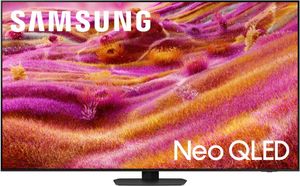
Bright rooms are where this one earns its keep. Neo QLED is Samsung’s Mini LED technology, built around much higher peak brightness than standard LED, which is exactly what a west-facing Valley great room demands at four in the afternoon. At 65 inches it fits the 8 to 13.5 foot seating range that describes most living rooms, and the 4K Ultra HD resolution holds detail at the close end of that range. Vision AI handles upscaling and picture adjustment on the fly. This is the pick for a sunlit room where blinds are not the answer.
Top Features
- Neo QLED Mini LED panel: Higher peak brightness than standard LED, which is the specification that beats daytime glare.
- 65 inch class size: Matches the 8 to 13.5 foot seating distance found in most standard living rooms.
- 4K Ultra HD resolution: Enough pixel density to sit at the immersive end of the distance range without visible pixel structure.
- Vision AI processing: Automatic upscaling and picture optimization across mixed sources like streaming, cable and gaming.
Samsung S85F 65” 4K Ultra HD OLED Vision AI Smart TV
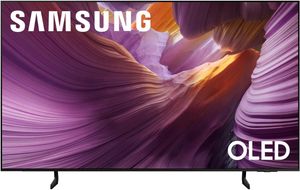
For a room where you control the light, OLED changes what a 65 inch screen can do. Every pixel produces its own light and shuts off completely for black, which delivers contrast that backlit panels cannot match and off-angle viewing that keeps the outer seats of a sectional looking as good as the center. That off-angle strength is the practical argument here, since wide seating is standard in open floor plans. The 65 inch size drops into the same mainstream distance range as the model above. This suits movie nights in a family room with controllable window coverings.
Top Features
- OLED self-lit panel: Pixel-level light control produces true black and the highest contrast of any panel type.
- Wide off-angle viewing: Picture quality holds up across a wide sectional instead of fading at the outer seats.
- 65 inch mainstream size: The most common living room size in the Valley, matched to 8 to 13.5 feet of seating distance.
- Vision AI smart platform: Built-in streaming and automatic picture handling across every input.
Samsung S90F 77” 4K Ultra HD OLED Vision AI Smart TV
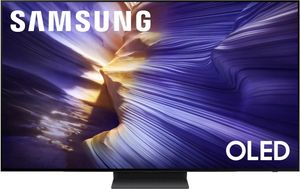
When the sofa sits 11 feet or more from the wall, this is the size the formula actually points to. At 77 inches the panel measures roughly 67 inches wide, so plan on about seven feet of clear wall and confirm the delivery path before ordering. The payoff is a cinematic viewing angle in a great room without moving furniture, combined with OLED contrast that makes dark scenes hold detail instead of turning gray. Wide off-angle performance matters even more at this size because the seating spread is usually wider. This is the large format choice for open great rooms and media spaces.
Top Features
- 77 inch large format size: Built for great rooms with seating at 10 to 16 feet, where 65 inches leaves the angle too narrow.
- OLED contrast in a big panel: Deep black levels across a large screen, which is where letterboxed films look their best.
- 4K Ultra HD detail: Pixel density that holds together at the close end of a large-screen seating range.
- Wide viewing angle: Consistent picture across the full width of a sectional or a second row of seating.
LG C5 Series 65” 4K Ultra HD OLED evo AI Smart TV
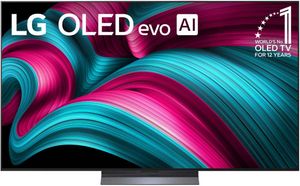
The C Series is LG’s mainstream OLED line and the one gamers ask about by name. OLED evo is the brighter version of LG’s OLED panel, which addresses the classic knock against OLED in a well-lit room, and the near-instant pixel response is what makes fast motion look clean whether the source is a console or a Sunday football game. At 65 inches it lands squarely in the standard living room distance range, and it works just as well at a shorter gaming distance. This is the balanced choice for a household that watches, streams and games on the same screen.
Top Features
- OLED evo panel: A brighter OLED variant that holds up better in rooms with real daylight.
- Fast pixel response: Clean motion handling for gaming and live sports without smearing.
- 65 inch class size: Comfortable at 8 to 13.5 feet for viewing and at the closer end for console gaming.
- LG AI processing: Scene-by-scene picture and sound adjustment across streaming, broadcast and game inputs.
LG G5 Series 65” 4K Ultra HD OLED evo AI Smart TV

The G Series sits above the C Series in LG’s OLED lineup and is built around flush wall mounting, which is why it is often called the gallery series. That design intent matters for the mounting section above: a set engineered to sit close to the wall changes how a media wall looks in a room where the screen is visible from the kitchen and entry. The brighter OLED evo panel again handles Arizona daylight better than earlier OLED generations. At 65 inches it fits standard seating distances while reading as a finished architectural element rather than a box on a bracket.
Top Features
- Flush wall mount design: Engineered to sit tight to the wall, which suits open floor plans where the screen is always in view.
- Step-up OLED evo panel: Higher brightness than the mainstream OLED tier for rooms with significant ambient light.
- 65 inch size with premium finish: Standard living room sizing in LG’s upper OLED tier.
- LG AI picture and sound: Automatic optimization tuned to content type and room conditions.
Answering What Size TV Do I Need for Your Home With Confidence
Measure your seating distance in inches, divide by 1.5 to 2.5 for your comfortable size range, then confirm the screen physically fits the wall, the console and the delivery path. Remember that 4K resolution made larger screens comfortable at closer distances than any pre-4K chart suggests, so the size that feels bold on paper is usually the one that feels right after a week. Panel quality still deserves a share of the budget alongside inches.
Come see the sizes side by side. Shop televisions online at Spencers TV & Appliance or visit one of our Valley showrooms, where you can stand at a measured distance and compare a 65 next to a 75 instead of guessing from a spec sheet. Our staff will ask about your room, your seating and your window exposure before recommending anything, and our own teams handle delivery, wall mounting, calibration and service after the sale right here in the Phoenix area. That hands-on support is what an independent Arizona retailer offers instead of a curbside drop from a warehouse and a phone number for a call center.
Read more:
Level Up Your Home Theater Setup This Summer
Frequently Asked Questions About What Size TV Do I Need
A 65 inch television is comfortable from roughly 8 to 13.5 feet, which comes from dividing your seating distance in inches by 1.5 for the immersive end and 2.5 for the relaxed end. Sitting near 8 feet produces a cinematic viewing angle close to the THX target, while 12 to 13 feet suits rooms where the television runs during dinner and homework.
A 75 inch television fits a standard living room whenever the primary seating sits about 9.5 feet or more from the screen, which describes most Valley living rooms. The more common limitation is wall width rather than distance, since a 75 inch panel measures roughly 65.5 inches across and looks best with about seven feet of clear wall.
Measure diagonally across the active display area from one corner to the opposite corner, excluding the bezel, frame and stand. The number you get will usually be slightly smaller than the advertised class size, since a 65 inch class model commonly measures about 64.5 inches, and manufacturers disclose that rounding in the spec sheet.
Most bedrooms suit a 43 to 55 inch television, since seating distance from a bed to the opposite wall typically runs 6 to 10 feet. Mounting height deserves more attention than size in a bedroom, because you view from a reclined position and a screen set too high forces an uncomfortable neck angle.
Yes, 4K resolution packs four times the pixels of 1080p into the same panel area, so pixel structure stays invisible at distances that would have looked coarse on an older screen. That higher pixel density is the reason modern sizing guidance recommends larger screens than charts written during the 1080p era.
The center of the screen should sit near seated eye level, which places it around 42 inches from the floor for typical sofa seating. Over-fireplace installations push that center height well above eye level, so a tilting mount becomes necessary and a slightly smaller screen often watches more comfortably than a larger one on a high wall.
Why Trust Spencers TV & Appliance?
Since 1973, Spencer’s TV & Appliance has grown to 11 locations throughout the Phoenix Metropolitan Area. The secret to our longevity is simple: personal service. Customer satisfaction has always been the focus of our business, and throughout the years, we have been able to work hard with our suppliers to bring you the best prices. After all, getting customers the best price and personal attention is how we compete with big-box stores, day in and day out.
Not only do we offer top-rated appliances, name-brand electronics, and the best mattresses on the market but we also provide water treatment solutions and perform kitchen design services. Stop by your nearest Spencer’s and see what you’re missing!
Shop Tvs at Spencers
At Spencers TV & Appliance, we provide high-quality, name-brand products at great prices. Your friends in the business are always happy to help you choose the best mattress for lower back and leg pain. Call us, or better yet, stop by at one of our locations in the Phoenix, Scottsdale, and Glendale regions. Visit us today!