

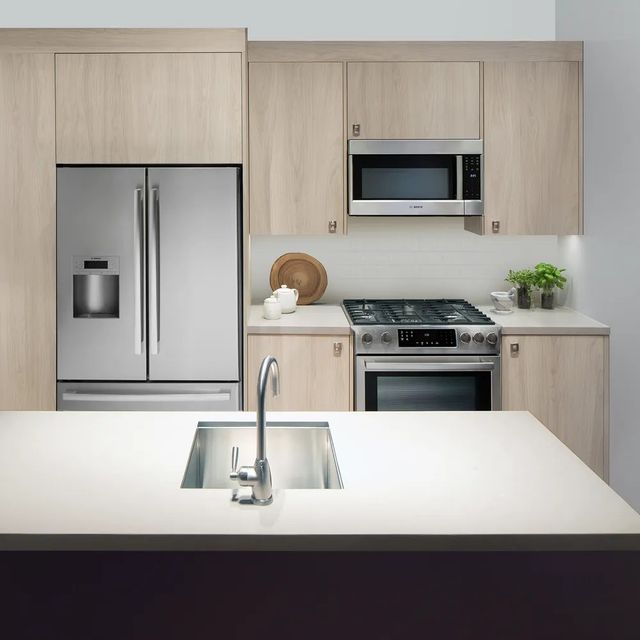
The dishwasher started twenty minutes ago and the conversation across the kitchen island has already turned into a guessing game, with everyone leaning in and repeating themselves over the hum. The next morning is worse. Plastic storage lids come out beaded with water, the deep bowls on the bottom rack are still wet, and the tub gives off a faint stale smell the second the door swings open. The machine is only four years old. That pairing of noise and half-dry dishes is what sends most Valley homeowners looking at the Bosch 500 Series in the first place, and it usually turns into a bigger conversation about the rest of the kitchen.
See the Bosch 500 Series Running Before You Buy
Our team compares Bosch tiers side by side, matches models to your actual cabinet openings, and handles delivery, installation, and service after the sale. Shop Bosch dishwashers, cooktops, ovens, and full kitchen packages in one place.
The encouraging part is that the tier that fixes all of this is not the most expensive one on the floor. Spencer’s TV & Appliance is an authorized Bosch dealer serving the Phoenix metro, and our team answers this exact question every week. What follows is where the 500 Series sits in the Bosch lineup, the six reasons it is the tier most homeowners land on, a side-by-side comparison against the 300 and 800 Series, and the honest trade-offs that never make it onto a spec sheet.
Key Takeaways
- Upper-mid tier, not entry level: The 500 Series sits above the 100 and 300 Series and below the 800 and Benchmark Series. All tiers share the same core engineering, so the number reflects features and finish rather than build quality.
- 44 dBA is the quiet threshold: Most 500 Series dishwashers run at 44 dBA, which is quiet enough to stop competing with conversation in an open-concept kitchen.
- AutoAir is the real upgrade over the 300 Series: The door cracks open at the end of the cycle to vent steam, which Bosch rates at roughly 40 percent drier dishes than condensation drying alone.
- The 500 Series spans the whole kitchen: Dishwashers, counter-depth refrigerators, induction and gas cooktops, speed ovens, over-the-range microwaves, and compact laundry all live at this tier.
What Is the Bosch 500 Series and Where It Sits in the Lineup
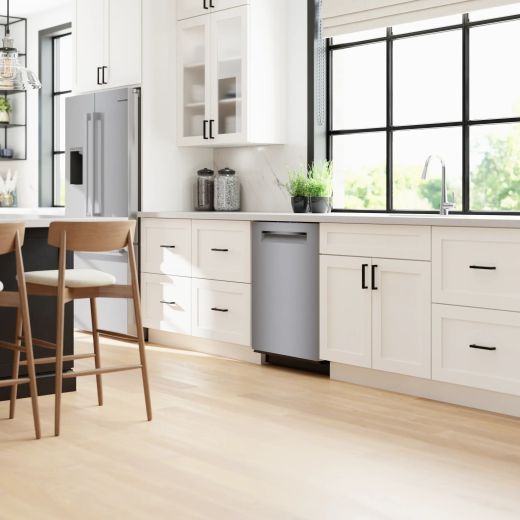
The Bosch 500 Series is Bosch’s upper-mid appliance tier, positioned above the 100 and 300 Series and below the 800 and Benchmark Series. That one sentence answers most of the confusion, but the full ladder is worth memorizing before you shop.
From entry to flagship, the order runs 100 Series, 300 Series, 500 Series, 800 Series, Benchmark Series. The series number is a feature and finish tier, not a size and not a quality grade. A 100 Series dishwasher and a Benchmark dishwasher share the same basic platform, the same sealed tub construction, and the same wash principles. What changes as you climb is drying performance, rack flexibility, smart connectivity, and finish options.
That distinction saves people money. You are not buying better cleaning chemistry when you step up. You are buying convenience, quieter running, and a more finished look.
The tier also covers far more than dishwashers, which is where a lot of shoppers get tripped up. At the 500 Series level you will find:
- Built-in dishwashers in front-control and top-control layouts
- French door and counter-depth refrigerators
- Slide-in induction and gas ranges
- Built-in wall ovens and speed ovens
- Induction, gas, and radiant electric cooktops
- Over-the-range microwaves
- Compact 24-inch front-load washers and ventless dryers
Bosch also redesigned the 500 Series dishwasher line for 2025, and the changes landed squarely at this tier. The refresh brought the Zone Wash spray arm, a Deep Clean cycle, and AutoAir drying down into the 500 Series, which narrowed the gap with the 800 Series noticeably.
The Terms You Will See on Every Spec Sheet
Five pieces of Bosch shorthand carry through the rest of this guide:
- dBA: the sound rating in A-weighted decibels. Lower is quieter, and the scale is logarithmic rather than linear.
- AutoAir: automatic door opening at the end of the wash cycle to vent steam and finish drying.
- PrecisionWash: sensors that read soil level continuously and adjust water, temperature, and cycle length.
- RackMatic: an adjustable middle rack that moves to three heights across nine total positions.
- Home Connect: the Bosch app platform for remote start, monitoring, alerts, and remote diagnostics.
Read more:
Reason 1: Genuinely Quiet Operation at 44 dBA
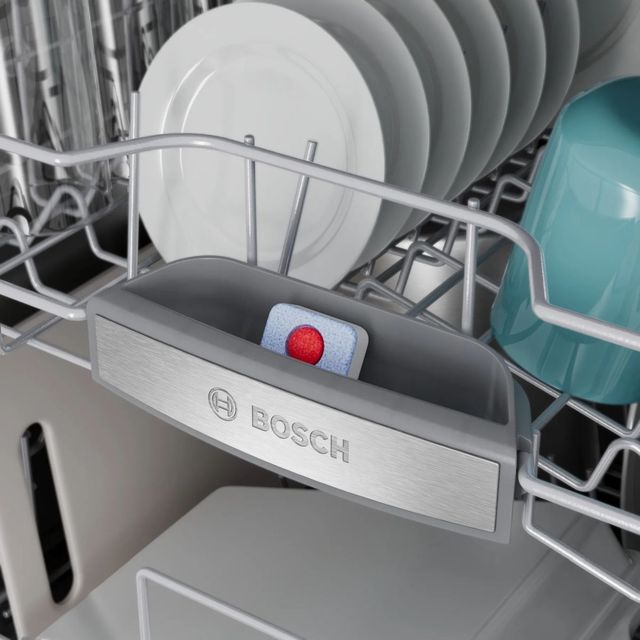
Most 500 Series dishwashers are rated 44 dBA. For comparison, the 100 Series lands in the 46 to 50 dBA range, and the 800 Series drops to 39 to 42 dBA.
Numbers on a page do not mean much until you translate them. A 44 dBA appliance sits in the same range as a quiet library or soft rainfall outside a closed window. Because the decibel scale is logarithmic, small numeric gaps are genuinely audible, and the drop below roughly 45 dBA is the point where a dishwasher stops competing with the conversation happening six feet away.
Bosch gets there through construction rather than software. Multi-layer insulation wraps the tub. The filtration system is grinderless, so there is no hard food disposer chewing away during the cycle, which is one of the loudest components in a conventional dishwasher. In 500 Series laundry, the brushless EcoSilence Drive motor does the same job on the washer side.
Why Quiet Matters More in Newer Homes
Older homes closed the kitchen off with walls. Modern floor plans do the opposite. Open-concept great rooms and kitchen islands put the dishwasher directly inside the living space, a few steps from the sofa and the television.
Phoenix-area new builds add another wrinkle. Tile and luxury vinyl plank reflect sound instead of absorbing it the way carpet and area rugs do, so the same appliance can read louder in a Valley home than in a Midwest kitchen with carpeted adjacent rooms.
Bosch anticipated the side effect of building something you cannot hear. InfoLight projects a small beam onto the floor so you know a cycle is still running. Top-control models hide the panel inside the door frame, which means there is no display on the door face at all, and the light on the floor becomes your only cue.
One thing that rarely gets mentioned: the rating on the box is measured under controlled conditions, and your kitchen is not a lab. Floor material, the size of the toe-kick gap, and whether the unit was properly leveled and shimmed into the cabinet opening all change what you actually hear. A perfectly good 44 dBA dishwasher can buzz if a corner is carrying weight it should not.
Reason 2: Cleaning Performance That Adapts to the Load
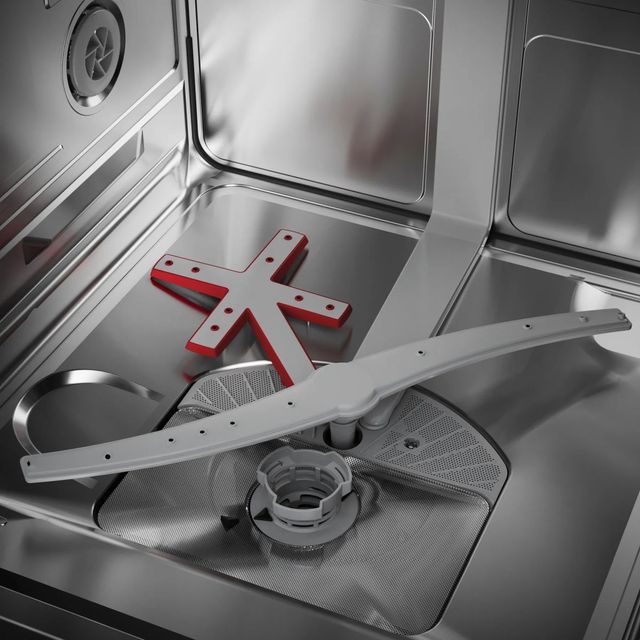
PrecisionWash is the reason Bosch tells you to skip the pre-rinse. Sensors scan the water for soil level throughout the cycle, not just at the start, then adjust water volume, temperature, and cycle length in response. A lightly soiled load finishes shorter and uses less water. A grease-heavy load gets more of both.
The redesigned 500 Series dishwasher adds the Zone Wash spray arm, which concentrates roughly three times more water pressure into the lower rack. That is aimed at the sheet pans, casserole dishes, and baked-on cheese that used to require an overnight soak. On top-control models it pairs with the Deep Clean cycle for the worst of it.
The cycle and option set at this tier gives you real control:
- Auto: which reads the load and decides for itself
- Heavy: for pans and cookware
- Normal: the daily default
- Express: for a fast turnaround on lightly soiled dishes
- Delicate: for stemware and fine items
- Half Load: when the dishwasher is not full
- Favorites: which saves a custom cycle and option combination you use often
- Extra Dry and Sanitize: as add-on options
Everything runs inside a sealed stainless steel tub with a three-part filtration system. There is a trade-off there, and it is the most common complaint we hear: with no food grinder, the filter has to be pulled and rinsed periodically. Plan on a rinse under the tap every month or two depending on how much you scrape before loading. It takes about ninety seconds.
The same adaptive thinking shows up across the suite. The 500 Series washer uses the 4D Wash System, which sprays detergent solution from multiple directions instead of relying on drum tumbling alone. The 500 Series refrigerator pairs MultiAirFlow cooling, which distributes cold air through multiple vents to hold a steadier temperature, with the UltraClarity Pro water filter on the dispenser and ice maker.
Hard Water Changes What You See on the Glasses
Valley tap water is hard, and that single fact causes more confusion than any feature on this list. Mineral content leaves a chalky film on glassware, and homeowners almost always read that film as a drying failure when it is actually a water chemistry problem.
Three levers fix it. Keep the rinse aid reservoir filled rather than skipping it, because rinse aid breaks surface tension so water sheets off instead of beading and evaporating in place. Set the water hardness level in the dishwasher settings to match your municipal water report. And if your home has a softener, confirm it is regenerating on schedule before blaming the appliance.
Reason 3: AutoAir Drying That Actually Finishes the Job
This is the single biggest reason to step up from the 300 Series, so it deserves the clearest explanation in this guide.
Bosch dishwashers use condensation drying. There is no exposed heating element in the bottom of the tub. Instead, the final rinse heats the dishes, and the cooler stainless steel tub wall pulls moisture out of the air and off the load, where it runs down and drains away. That approach is gentler on plastics, since nothing melts or warps against a glowing element, and it is part of why the tub can be fully sealed.
AutoAir takes it a step further. At the end of the cycle, the door cracks open automatically to vent the humid air out of the tub. Bosch rates the result at roughly 40 percent drier dishes than condensation drying alone. In practice, that is the difference between unloading right away and coming back with a towel.
Now the honest part. AutoAir does not fully match CrystalDry, which is what the 800 Series and Benchmark use. CrystalDry packs a zeolite mineral into the machine that absorbs moisture and converts it into heat, pushing tub temperatures higher during the dry phase. Deep-bottomed items and plastic containers come out drier on those models. If your household runs meal-prep containers through the dishwasher daily, that is the tier worth the extra money. For everyone else, AutoAir closes most of the gap.
What Nobody Tells You About a Door That Opens Itself
An auto-opening door has consequences the marketing copy skips:
- It needs clear space in front of the dishwasher at the end of every cycle.
- It releases a visible puff of humid air, which is worth thinking about under a wood cabinet run or a painted cabinet face.
- In a tight galley kitchen, a door that pops open on its own becomes a walking hazard if the cycle finishes while people are moving through.
- The habit that fixes most of it is simple: unload the bottom rack first, so water sitting in the recesses of upturned cups on the upper rack does not spill onto dishes you already dried.
- Run Extra Dry together with rinse aid if you want maximum performance from AutoAir. The two work on different parts of the same problem.
The drying story extends into laundry, and it is arguably a bigger deal there. The 500 Series compact dryer uses heat pump technology, which recirculates and dehumidifies air instead of heating it and blowing it outside. That makes it fully ventless, so it installs almost anywhere with a standard outlet, including a hall closet, an upstairs laundry nook, or a casita. The condenser is self-cleaning, and because drying temperatures stay lower across every cycle, fabrics take less abuse over hundreds of loads.
Reason 4: European Design and a Flush, Built-In Fit
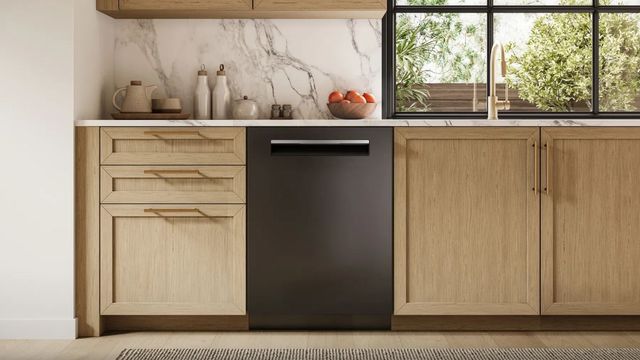
Fit is where the 500 Series separates itself from mass-market brands, and fit is mostly about depth.
Counter-depth refrigerator models around 21.6 cubic feet are built to sit flush with standard 24-inch cabinetry, so the doors and handles are the only things breaking the plane of the counter. Standard-depth models around 26 cubic feet give you roughly four more cubic feet of storage but project several inches past the cabinet run. Households that host and store bulk groceries usually take the volume. Kitchens where the refrigerator is visible from the living room usually take the flush line.
Dishwasher styling works the same way. You can choose a pocket handle for a flat, recessed look or a towel bar handle for a more traditional profile. Top-control models put every button inside the door frame, so the front face is a clean rectangle of stainless. That gives you a nearly integrated appearance without paying for a panel-ready 800 Series unit and a custom cabinet panel.
Finishes matter more in daily life than people expect. Anti-fingerprint stainless steel is the practical pick for a kitchen with kids, because it resists the palm prints and smudges that make regular stainless look dirty an hour after cleaning. Black stainless and white are also available at this tier for kitchens built around a darker or lighter palette.
On the cooking side, 30-inch slide-in induction and gas ranges drop into an existing cutout, and the slide-in profile removes the tall rear backguard so the counter reads as one continuous surface behind the cooktop. Continuous cast-iron grates on the gas models let you slide a heavy pan from burner to burner instead of lifting it. Frameless cooktops take the same idea further by sitting nearly level with the stone around them.
Compact laundry deserves its own mention as a space solution. A 24-inch stackable washer and ventless dryer pair fits in a footprint that a full-size set cannot touch, which opens up condos, apartments, guest casitas, and second-floor laundry closets where no exterior vent run exists.
Measure Before You Order, Not After
Appliance returns almost always trace back to a measurement nobody took. Before ordering anything at this tier, check:
- Cutout width at the narrowest point, not the widest.
- Depth including door swing and handle projection, not just the box depth.
- Hinge clearance against adjacent walls, cabinet runs, and island corners.
- Water supply, drain, and power locations relative to the new unit’s connection points.
- The path from your front door to the kitchen, including doorway widths and any turns.
Here is the installation detail our team checks on every Bosch dishwasher job: the drain hose has to be looped up and secured to the underside of the countertop, at least 20 inches above the floor, before it drops down to the disposer or standpipe. Bosch specifies that high loop in the installation instructions, and skipping it lets dirty sink water siphon backward into the tub. It is also the most common reason a brand-new dishwasher smells stale after a few weeks.
Bring your kitchen measurements to any Spencer’s showroom and our team will check them against the spec sheet before your order is placed.
Bosch 300 vs 500 vs 800 Series: Side-by-Side Comparison
Dishwashers are the highest-volume comparison in the Bosch lineup, so start there. Read across the row that matters most to you.
| Feature | 300 Series | 500 Series | 800 Series |
|---|---|---|---|
| Sound Rating in dBA | 44 dBA | 44 dBA | 39 to 42 dBA |
| Drying Technology | Condensation drying | AutoAir door venting | CrystalDry with zeolite |
| Third Rack | Standard on most models | Standard with utensil slots | Standard, deeper flexible rack |
| Adjustable Middle Rack | Fixed height on most models | RackMatic, 3 heights and 9 positions | RackMatic, 3 heights and 9 positions |
| Wash Zone Technology | PrecisionWash | PrecisionWash plus Zone Wash arm | PrecisionWash plus Zone Wash and PowerControl |
| Cycles and Options | About 5 cycles and 5 options | About 6 cycles and 6 options | About 6 cycles and 8 options |
| Control Style | Front control and top control | Top control with hidden panel | Top control and panel-ready |
| Available Finishes | Stainless, black stainless, white | Anti-fingerprint stainless, black stainless, white | Stainless, black stainless, white, custom panel |
| Leak Protection | AquaStop | AquaStop | AquaStop |
| Smart Connectivity | Home Connect on select models | Home Connect standard | Home Connect standard |
| Typical Price Range | Roughly 850 to 1,000 dollars | Roughly 1,000 to 1,300 dollars | Roughly 1,300 to 1,700 dollars |
Notice that the 300 and 500 Series carry the identical 44 dBA sound rating. The upgrade between those two tiers buys drying performance, rack glide and adjustability, and more cycles and options. It does not buy quiet, because you already have it at the 300 Series.
Price bands above are approximate and move with promotions, so confirm current pricing on the Spencer’s product pages or with our team.
Because this tier spans the whole kitchen, here is how the 500 Series expresses itself by category:
| Category | Signature 500 Series Technology | Best For |
|---|---|---|
| Dishwashers | AutoAir drying with Zone Wash arm | Open-concept kitchens that run a cycle during dinner |
| Refrigerators | MultiAirFlow cooling and UltraClarity Pro filtration | Remodels that need a flush counter-depth line |
| Cooktops | Induction boost elements and continuous grates | Replacing a builder-grade cooktop in an existing cutout |
| Speed Ovens | Convection plus microwave in one cavity | Small households and second cooking zones |
| Over-the-Range Microwaves | Sensor cooking with integrated venting | Kitchens with no room for a separate hood |
| Compact Laundry | Ventless heat pump drying and EcoSilence Drive | Condos, casitas, and upstairs laundry closets |
Reason 5: Home Connect Puts the Whole Kitchen on Your Phone
Wi-Fi enabled is a meaningless phrase on a spec sheet. What Home Connect actually does is more specific:
- Remote start and cycle monitoring from anywhere with a signal
- Push notifications when a cycle finishes or a setting needs attention
- SmartDry assistance that helps dial in dryer settings by load type
- Remote diagnostics that let a technician read fault data before the truck rolls
- Over-the-air updates that add features after the appliance is already installed
Those turn into real behavior fast. You start the dishwasher from the car so it finishes before dinner instead of running during it. You set laundry on delayed start and get a notification the moment the load is done, so nothing sits damp in the drum overnight. You get an alert when a refrigerator door has been left ajar, which in a 115-degree July is not a small thing.
Speaking of heat, the 500 Series refrigerator adds features built for exactly this climate. QuickIce Pro speeds up ice production and recovery, which matters when a single afternoon of guests can empty a bin. BottleFill dispenses a preset volume hands-free so you can fill a water bottle without holding the lever.
If You Have No Interest in Apps
This is a fair objection and it deserves a straight answer. Every 500 Series appliance works completely without the app. Connectivity is a convenience layer, not a dependency. If your Wi-Fi drops, the dishwasher still washes, the dryer still dries, and every control on the unit keeps working exactly as it did. You lose remote start and notifications until the network comes back, and nothing else.
If you do want it, Home Connect also supports voice assistants, and connected Bosch appliances share the same app, so a suite purchase compounds the benefit instead of adding a second login.
One setup note worth planning around: Home Connect needs a 2.4 GHz network within range of the appliance. A dishwasher sitting behind a cabinet face and a wall of plumbing gets a weaker signal than your phone does standing in the same spot. If the kitchen sits far from the router, a mesh node in the hallway solves it before it becomes a support call.
Reason 6: Energy Efficiency and Long-Term Value
Sticker price is the wrong number to compare. Total cost of ownership over ten years is the right one, and it includes water, electricity, gas, detergent, and repairs.
ENERGY STAR certification runs across 500 Series dishwashers, refrigerators, and laundry, and the mechanisms behind it are worth knowing:
- Sensor-driven water use, so a light load never gets a heavy load’s water bill
- Heat pump drying, which reuses heat instead of exhausting it
- Inverter compressors in refrigeration that modulate speed rather than cycling full on and full off
- Low-temperature wash cycles that clean without heating as much water
Some real levers you control: a dishwasher using roughly two to three gallons per cycle uses less water than washing the same load by hand at the sink. The 1600 RPM spin speed on the 500 Series washer pulls more water out of the fabric mechanically, which shortens every dryer cycle that follows. And ventless heat pump drying consistently uses less energy than a vented electric dryer.
Arizona makes two of these worth more than they would be elsewhere. Many Valley utility plans charge peak-hour rates in the late afternoon and early evening, so delayed start is a direct savings tool rather than a novelty. And a ventless dryer does not blow conditioned air out of your house all summer, which a vented dryer does every single load.
The Value Argument Against Both Neighbors
Against the 300 Series, the 500 Series captures nearly every upgrade a normal household will notice, for a modest premium. AutoAir, RackMatic, standard connectivity, and the anti-fingerprint finish all arrive here.
Against the 800 Series, the premium buys refinements that matter intensely to a narrower group: CrystalDry, a lower sound floor, ball-bearing rack glides, and panel-ready options.
Warranty and service deserve honesty too. Bosch covers these appliances with a standard one-year limited warranty, and extended coverage is available at purchase. Over a ten-year ownership window, though, parts availability and access to trained service technicians matter more than any line on a spec sheet. That is the part an online-only seller cannot help with.
One more value note: buying a matched 500 Series suite often comes with package rebates that a single-unit purchase does not qualify for. Ask our team about current Bosch package offers before you buy pieces one at a time.
Bosch 500 Series Advantages and Disadvantages Before You Buy
The 500 Series is the tier where Bosch’s signature quiet, sensor-driven cleaning, and built-in fit all show up together in the same appliance. The compromises are real, but they are specific and predictable rather than deal-breaking, which makes them easy to decide about in advance.
Pros
Quiet enough for open floor plans
At 44 dBA, the dishwasher stops competing with conversation, television, and phone calls happening in the same room.
AutoAir closes most of the drying gap
Automatic door venting delivers roughly 40 percent drier dishes than condensation drying alone, at a fraction of the step up to CrystalDry.
Loading flexibility that fits real dishes
RackMatic moves the middle rack to three heights across nine positions, and the third rack handles utensils and small items that clog a silverware basket.
Built-in appearance without custom pricing
Counter-depth refrigerators, top-control dishwashers, slide-in ranges, and frameless cooktops read as designed-in rather than dropped-in.
Home Connect adds genuine convenience
Remote start, cycle alerts, and remote diagnostics that let a technician pre-read fault codes all come standard at this tier.
Cons
Plastics still finish damp
Deep-bottomed items and storage containers dry less completely than they would on an 800 Series or Benchmark model with CrystalDry.
Longer cycles and manual filter care
Sensor-driven, low-water washing takes more time than a high-heat blast, and the grinderless filter needs a rinse under the tap every month or two.
Read more:
Who Should Choose the Bosch 500 Series and Who Should Look Elsewhere
The best tier is the one that matches your kitchen and your habits, so skip the star ratings and find yourself in one of these three groups.
Choose the 500 Series If
- Your kitchen is open to the living space and appliance noise carries.
- You are replacing builder-grade appliances and want a clear jump in daily experience.
- Your remodel needs a flush, built-in look on a defined budget.
- You are buying a matched suite and want consistent handles, finishes, and panel alignment.
- You want smart features standard instead of scattered across select models.
Step Up to the 800 Series or Benchmark If
- Your household washes large volumes of plastic containers and meal-prep lids.
- The dishwasher shares a wall with a bedroom or a home office, where 39 dBA beats 44 dBA.
- You need panel-ready fronts or a wider finish selection to match custom cabinetry.
- You want ball-bearing rack glides for the smoothest possible rack action.
Stay With the 300 Series If
- Budget is the binding constraint on the project.
- Your dishes usually air-dry on a rack anyway, which makes drying technology less relevant.
- Quiet is your only priority, since the sound rating is identical at 44 dBA.
Household fit matters just as much as tier. Match refrigerator capacity to family size, then decide whether a flush counter line is worth roughly four cubic feet of storage. Compare compact laundry to full-size against your real load volume, not your worst laundry week. And if you are torn, come stand in front of a running 500 Series dishwasher in a Spencer’s showroom and pull the racks with your own dish shapes in mind. Sound and rack fit are the two things a spec sheet cannot convey.
How to Match a Bosch 500 Series Cooktop and Oven to the Way You Cook
Almost every Bosch guide online stops at the dishwasher, which leaves the cooking side of this tier unexplained. The choice between induction, gas, and radiant electric is less about power than about what is already behind your wall and how you actually cook. Induction moves energy directly into the pan and lands around 85 percent efficient, compared to roughly 40 percent for gas, which is why an induction element boils a pot of water in about half the time and dumps far less waste heat into a Phoenix kitchen in July. It also requires magnetic cookware and a dedicated 240-volt circuit. Gas gives you visible flame control and works with any pan you own, including copper and glass. Radiant electric is the least expensive way to fill a narrow opening and needs no gas line at all. The oven side has a parallel decision: a speed oven combines convection baking and microwave power in one cavity, while an over-the-range microwave doubles as your ventilation.
Use these matchups to narrow it down fast:
- High-heat searing with cast iron or clad stainless, plus a preference for a cooler kitchen: induction.
- A wok, a gas line already stubbed in, or a cook who works by watching the flame: gas.
- A casita, wet bar, or second kitchen with a 24-inch opening and no gas service: radiant electric.
- No hood and no room to add one: an over-the-range microwave that vents and reheats in a single opening.
- A small household that bakes, reheats, and roasts in modest quantities: a speed oven instead of a full second wall oven.
- A stone or quartz counter with a frameless cooktop: give your fabricator the exact model cutout template before the slab is routed, because frameless models leave no overlapping edge to hide a sloppy cut.
Read more:
Shop Bosch 500 Series Dishwashers at Spencer’s TV & Appliance
Here is where the reasons above turn into actual appliances. Every model below is a 500 Series 24-inch top-control built-in dishwasher, so the wash system, the 44 dBA rating, and the AutoAir drying are the same across all four. What changes is the finish and the handle, which is really a question of what the rest of your kitchen looks like. Everything here is available to see in person and to schedule with professional delivery and installation.
Bosch 500 Series 24” Stainless Steel Top Control Built-In Dishwasher
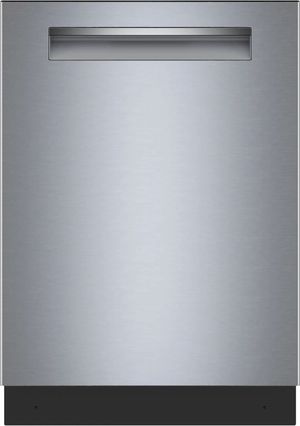
This is the model that answers the 9 p.m. problem from the top of this guide. It runs at 44 dBA, so a cycle during dinner stays out of the conversation, and AutoAir cracks the door at the end to vent steam for roughly 40 percent drier dishes than condensation drying alone. The top-control panel hides inside the door frame for a clean stainless face, RackMatic moves the middle rack across nine positions, and the third rack takes utensils and small items. AquaStop leak protection and a sealed stainless tub round it out. Worth hearing in a showroom.
Top Features
- 44 dBA sound rating: Quiet enough to run during dinner in an open-concept kitchen without interrupting conversation.
- AutoAir drying: Automatic door venting finishes the load roughly 40 percent drier than condensation drying alone.
- RackMatic and third rack: Three rack heights across nine positions, plus a top rack for utensils and small items.
- Hidden top-control panel: Every button sits inside the door frame for a nearly integrated stainless front.
- AquaStop leak protection: Multi-stage system shuts off water supply if a leak is detected.
Bosch 500 Series 24” Anti-Fingerprint Stainless Steel Top Control Built-In Dishwasher
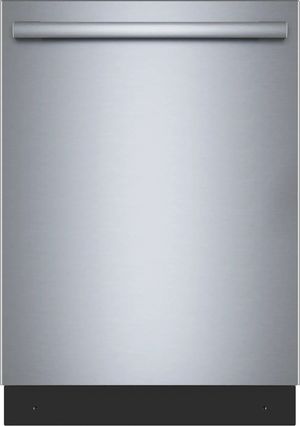
Anti-fingerprint stainless is the finish to pick if the dishwasher sits at kid height and gets touched all day. It resists the palm prints and smudges that make ordinary stainless look dirty an hour after wiping, which matters on a door that faces the living room. This one wears a bar handle rather than a pocket handle, so it reads a little more traditional next to shaker cabinetry and gives you something to grab with a full hand. Underneath the finish it is the same 44 dBA machine: AutoAir venting for roughly 40 percent drier dishes, Zone Wash pressure aimed at the lower rack, RackMatic across nine positions, and 16 place settings of capacity.
Top Features
- Anti-fingerprint stainless finish: Resists the smudges and palm prints that show up on standard stainless within an hour of cleaning.
- Bar handle styling: A towel bar profile that suits traditional and transitional cabinetry and is easy to grab with a full hand.
- 44 dBA with AutoAir drying: Quiet enough to run through dinner, with automatic door venting for roughly 40 percent drier dishes.
- Zone Wash and 16 place settings: Extra pressure concentrated in the lower rack for pans, with room for a holiday-sized load.
- Home Connect and AquaStop standard: Remote start and cycle alerts from your phone, plus a leak system that shuts off the water supply on its own.
Bosch 500 Series 24” Black Top Control Built-In Dishwasher
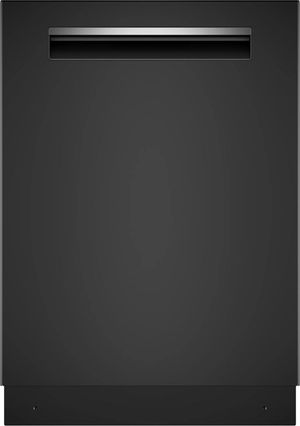
Black is the answer for a kitchen built around dark cabinetry, a two-tone palette, or a run of existing black appliances you are not replacing all at once. Paired with the pocket handle, the front becomes a flat black rectangle with no display and no protruding bar, which is about as quiet as an appliance face can look in a room where the kitchen is visible from the sofa. Everything behind that door is standard 500 Series: 44 dBA, AutoAir drying, Zone Wash, a third rack with RackMatic, and 16 place settings inside a sealed stainless tub.
Top Features
- True black finish: Blends into dark or two-tone cabinetry instead of interrupting it the way a stainless panel does.
- Pocket handle profile: A recessed handle keeps the door face flat, with no bar breaking the cabinet line.
- 44 dBA sound rating: The same quiet threshold as the rest of the tier, with InfoLight on the floor to tell you it is running.
- AutoAir drying: The door cracks open at the end of the cycle to vent steam for roughly 40 percent drier dishes.
- 16 place settings with third rack: RackMatic moves the middle rack across nine positions, and the top rack takes utensils and small items.
Bosch 500 Series 24” White Top Control Built-In Dishwasher
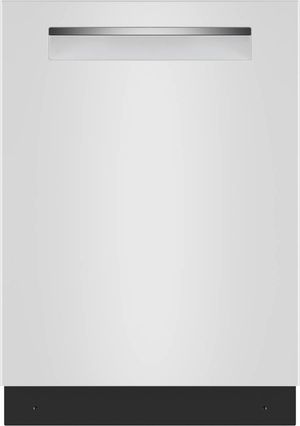
White is easy to overlook and often the right call. It is the finish that lets you replace one failed dishwasher in an established white kitchen without the new unit announcing itself, and it is the natural pick for bright, painted, and coastal-leaning cabinetry where stainless reads cold. Because the controls sit inside the door frame, the front is an uninterrupted white face with nothing on it, and InfoLight puts a small beam on the floor so a 44 dBA machine you cannot hear still tells you it is working. Feature for feature it matches the black and stainless models: AutoAir, Zone Wash with the Deep Clean cycle, EasyGlide racks, and Home Connect.
Top Features
- White finish: Matches an existing white appliance run or bright painted cabinetry without a stainless mismatch.
- Clean top-control face: Every button hides inside the door frame, so nothing breaks up the front panel.
- InfoLight on the floor: A small projected beam confirms a cycle is running on a dishwasher you cannot hear.
- Zone Wash and Deep Clean: Concentrated lower-rack pressure and a dedicated cycle for baked-on pans and casserole dishes.
- AutoAir drying and EasyGlide racks: Automatic door venting for roughly 40 percent drier dishes, on racks that pull out smoothly when loaded.
The Bosch 500 Series Hits the Sweet Spot for Most Kitchens
The Bosch 500 Series pairs 44 dBA quiet and sensor-driven cleaning with AutoAir drying, built-in styling, and Home Connect standard across the tier. It captures nearly all of the premium Bosch experience without premium pricing, and the trade-offs it asks for are specific enough that you can decide about them before you buy.
Ready to see it in person? Shop Bosch 500 Series dishwashers, refrigerators, cooktops, ovens, and laundry at Spencer’s TV & Appliance online or in any Valley showroom. As an authorized Bosch dealer, our team can run a unit in the showroom so you hear the difference between tiers, compare 300 against 500 against 800 side by side, and check your cutout measurements before the order goes in. Our own delivery and installation crews handle water lines, gas connections, and cabinet openings, and our service department is here in the Phoenix metro after the sale. That is the difference between buying from neighbors and buying from a warehouse.
Frequently Asked Questions about Bosch 500 Series Dishwashers
The biggest difference between the Bosch 300 and 500 Series is drying, since the 300 Series uses condensation drying while the 500 Series adds AutoAir door venting for roughly 40 percent drier dishes. The 500 Series also adds RackMatic middle rack adjustment, the Zone Wash spray arm, more cycles and options, and standard Home Connect connectivity.
For most households the Bosch 500 Series dishwasher is worth the step up, mainly because AutoAir drying removes the need to towel off dishes after nearly every cycle. If your dishes typically air-dry on a rack anyway and budget is tight, the 300 Series delivers the same 44 dBA quiet for less.
Most Bosch 500 Series dishwashers are rated at 44 dBA, which is comparable to a quiet library or soft rainfall and quiet enough to run during dinner. Multi-layer insulation and a grinderless filtration system with no food disposer are what get it there.
Yes, the Bosch 500 Series dries well using condensation drying plus AutoAir, which vents humid air by cracking the door open at the end of the cycle. Plastics and deep-bottomed items still finish drier on 800 Series and Benchmark models that use CrystalDry with zeolite mineral.
The Bosch 800 Series is quieter at 39 to 42 dBA and uses CrystalDry instead of AutoAir, so plastics and deep items come out drier. It also adds ball-bearing rack glides, panel-ready fronts, and a wider finish selection, which matters most for custom cabinetry and dishwashers placed near bedrooms.
Bosch 500 Series appliances typically last around 10 to 12 years with routine maintenance, and dishwashers often reach the upper end of that range. Rinsing the filter regularly, keeping rinse aid topped off, and using a local service department for repairs all extend that window.
Why Trust Spencers TV & Appliance?
Since 1973, Spencer’s TV & Appliance has grown to 11 locations throughout the Phoenix Metropolitan Area. The secret to our longevity is simple: personal service. Customer satisfaction has always been the focus of our business, and throughout the years, we have been able to work hard with our suppliers to bring you the best prices. After all, getting customers the best price and personal attention is how we compete with big-box stores, day in and day out.
Not only do we offer top-rated appliances, name-brand electronics, and the best mattresses on the market but we also provide water treatment solutions and perform kitchen design services. Stop by your nearest Spencer’s and see what you’re missing!
Shop Dishwashers at Spencers
At Spencers TV & Appliance, we provide high-quality, name-brand products at great prices. Your friends in the business are always happy to help you choose the best mattress for lower back and leg pain. Call us, or better yet, stop by at one of our locations in the Phoenix, Scottsdale, and Glendale regions. Visit us today!