
At a Glance
Saturday morning starts with a king comforter shoved into a washer drum that will not tumble, just slump and thud while the machine walks a half inch across the laundry room floor on the spin cycle. Stacked on top of the dryer sit two loads of bath towels, a set of queen sheets, and four soccer uniforms that have to be clean by noon. The realistic options are running the same machine three more times or loading everything into the back seat and driving to a laundromat, and both of those options exist because the drum is too small for the way this household actually does laundry. That single number, the large washing machine capacity rating printed on the spec sheet, quietly decides how long laundry day takes.
Find the Washer Capacity That Matches Your Real Laundry Load
Spencers TV and Appliance has been helping Arizona families size washers and dryers since 1973, from Phoenix garage laundry rooms to Scottsdale second-floor closets. Shop top load and front load washers with delivery, hookup, and haul-away handled by our own crews.
Explore large washing machine capacityThe fix is simpler than most shoppers expect, and it starts with understanding what those cubic foot numbers actually mean once laundry goes in the drum. At Spencers TV and Appliance, our appliance team sizes washers for households across the Phoenix metro every week, which means asking about weekly load counts and laundry room dimensions before talking about brands. This guide covers how washer capacity is measured, what genuinely counts as large capacity, how to match a drum to your household, how front load and top load designs behave at high capacity, the fit and hookup requirements that trip people up, the features worth paying for, and the sizing mistakes that lead to regret.
Key Takeaways
- Capacity is drum volume, not cabinet size: Washer capacity is measured in cubic feet of interior drum space, so a bigger drum does not automatically mean a wider machine that will not fit your laundry closet.
- Most families land between 4.5 and 5.0 cubic feet: That range washes a king comforter in one pass and covers a family of four without forcing longer cycles than the household needs.
- Drum style changes usable space: An agitator post eats volume that impeller and front load drums put to work, so two machines with the same rating can hold noticeably different loads.
- The dryer has to keep up: A full wash load that will not fit in one drying cycle cancels out most of the time a larger washer was supposed to save.
How Washing Machine Capacity Is Measured
Washer capacity is the interior volume of the wash drum, expressed in cubic feet. Manufacturers calculate it from the drum diameter and depth, so a wider basket or a deeper one both push the number up. The figure most brands publish follows the IEC capacity rating method, which is why two models measured the same way can be compared directly even across brands.
Those numbers fall into practical tiers that make any model easy to place:
- Compact: under roughly 2.5 cubic feet, typical of 24 inch apartment machines
- Standard: about 3.5 to 4.2 cubic feet, the traditional full size drum
- Large: about 4.3 to 4.9 cubic feet
- Extra large or mega capacity: roughly 5.0 cubic feet and up
A large washing machine capacity generally starts around 4.3 cubic feet, though brand marketing language is inconsistent. One company calls 4.5 cubic feet mega capacity while another reserves that phrase for 5.8. The cubic foot number on the spec sheet is the only part of that conversation worth trusting.
Drum Capacity Is Not Cabinet Size
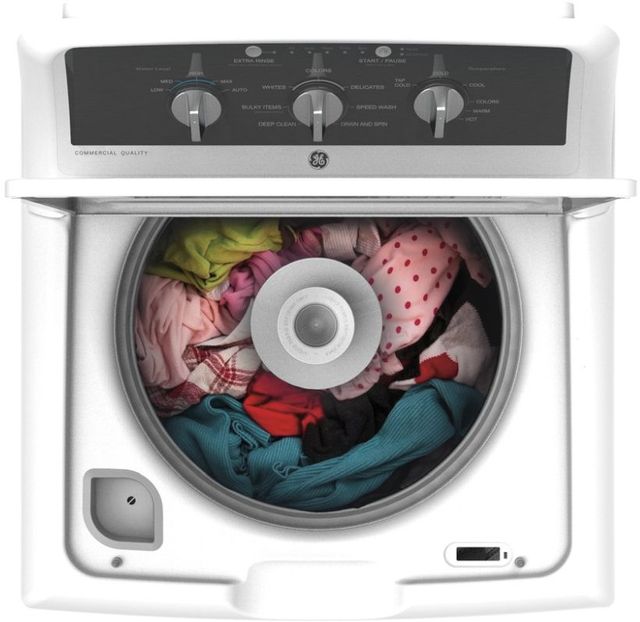
This is where a lot of shoppers get confused. Nearly every full size washer sold in the United States is about 27 inches wide, whether it holds 4.0 cubic feet or 5.5. Extra capacity usually comes from a deeper cabinet or a differently shaped basket, not a wider one. Measuring your laundry closet width and assuming that caps your capacity is a mistake that costs people real drum space.
What the Wash System Costs You
An agitator is the tall post standing in the middle of a top load drum, and it occupies volume you cannot fill with laundry. An impeller, sometimes called a wash plate, is a low disc or cone sitting flat at the bottom of the basket, leaving the drum floor open. Front load drums have nothing in the middle at all.
The result is that a 4.5 cubic foot agitator washer holds meaningfully less usable laundry than a 4.5 cubic foot front load washer, even though the label is identical. Comparing raw cubic feet across wash systems overstates what the agitator model can really do.
Read more:
7 Best Heavy Duty Washing Machines for Large Loads
LG Front Load Washing Machine: Features Pros Love
Translating Cubic Feet Into Real Laundry
Numbers on a tag are abstract until they turn into towels. As a working rule, a washer handles roughly four to five pounds of dry laundry per cubic foot of drum space when it is loaded correctly rather than packed:
- 4.0 cubic feet: about 16 to 18 pounds, or roughly 10 to 12 bath towels
- 4.5 cubic feet: about 18 to 21 pounds, or roughly 12 to 15 bath towels
- 5.0 cubic feet: about 22 to 25 pounds, or roughly 15 to 18 bath towels
- 5.5 cubic feet: about 26 to 30 pounds, or roughly 18 to 22 bath towels
A queen comforter needs about 4.0 cubic feet to move freely. A king comforter wants 4.5 or more, and a king with a mattress pad in the same load wants 5.0.
Matching Washer Capacity to Your Household and Laundry Habits
Headcount is the starting point, not the answer. Still, it puts most households in the right neighborhood before the details adjust the number.
- One or two people: 3.5 to 4.2 cubic feet handles a week of clothing in two loads
- A family of three or four: 4.5 to 5.0 cubic feet is the sweet spot, and it is where most Phoenix households we work with land
- A family of five or more: 5.0 to 5.5 cubic feet keeps laundry day from taking the whole weekend
- Heavy or bulky laundry at any headcount: 5.0 cubic feet and up regardless of how many people live there
The Factors That Override Headcount
Two people can generate more laundry than a family of five. What actually drives volume is what goes in the hamper and how often:
- Dogs and cats, especially large dog beds and washable crate pads
- Youth sports, where uniforms, practice gear, and towels come home wet several times a week
- Trade and construction work clothes that cannot be mixed with anything else
- Cloth diapers, which demand frequent small hot loads on their own schedule
- Guest rooms in regular use, which turn sheets and towels over constantly
- Households that prefer one long laundry day over three short ones
Bulky Items Are Usually the Real Reason to Upsize
Most people do not upsize because of clothing. They upsize because something big will not fit. A king comforter, a mattress pad, a sleeping bag, a winter coat, or a 5 by 7 area rug are the items that expose a small drum. A king comforter needs roughly 4.5 cubic feet minimum and behaves much better at 5.0. A sleeping bag or a set of two pillows wants similar room. An area rug depends entirely on backing, and rubber-backed rugs should stay out of the washer no matter the capacity.
A Larger Washer Does Not Mean Faster Laundry
A bigger drum means fewer loads, but each load runs longer because there is more fabric to wet, agitate, rinse, and spin. Four small loads and two large loads can consume similar total machine hours. What changes is your involvement, since you load, unload, and transfer half as many times. Fewer touches, not fewer minutes, is the honest benefit.
Can a Washer Be Too Big?
Yes, though not in the way people fear. Modern load sensing adjusts water to the weight in the drum, so a small load in a 5.3 cubic foot washer does not waste a full tub of water. The real penalties are the purchase price you paid for volume you never use, the extra cabinet depth in a tight laundry room, and small-load wash quality in an impeller machine, which needs garments touching each other to clean. A nearly empty low-water drum gives clothes nothing to rub against.
Count Your Loads Before You Shop
Run this before you set a budget. For two normal weeks, keep a note on your phone and write down every load you run, what was in it, and whether the drum was full, half full, or overstuffed. At the end, count them.
- Six or fewer full loads a week with nothing bulky: 4.3 to 4.5 cubic feet is plenty
- Seven to ten loads a week: 4.5 to 5.0 cubic feet cuts that number down meaningfully
- More than ten loads, or two or more overstuffed loads a week: go 5.0 and up
- Any week that included a comforter you had to take somewhere else: 5.0 and up
That two-week log tells you more than any capacity chart, because it measures your house instead of an average one.
Front Load Versus Top Load at Large Capacities
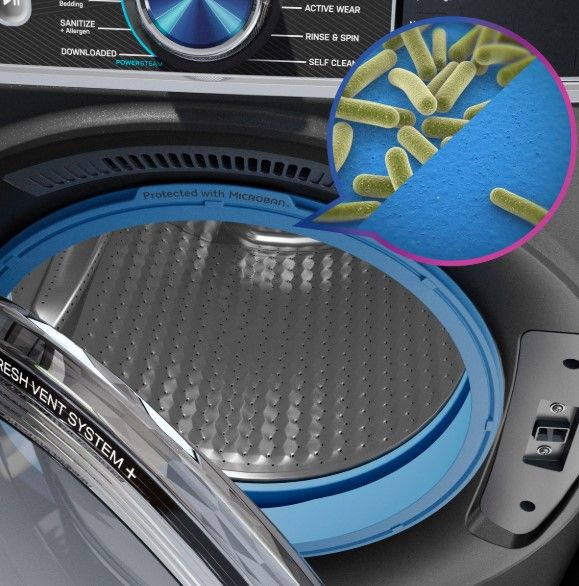
Three configurations show up once you cross into large capacity, and they behave differently enough that the choice matters more than the brand badge. Whirlpool, Maytag, LG, Samsung, GE, and Speed Queen all build strong machines in more than one of these styles, so the design decision comes first.
Front Load Washers
Front load washers reach the highest usable capacity per cabinet because nothing occupies the drum interior. The drum tilts on its axis and tumbles laundry through a shallow pool of water, which is why bulky items circulate instead of wrapping around anything. They also use the least water and spin the fastest, commonly 1,200 RPM or more on premium models, which pulls more moisture out before the load ever reaches the dryer.
The ownership realities are real too. The door gasket needs wiping and the door needs to be left ajar between loads or it develops odor. You bend to load and unload unless you buy a pedestal. Front load washers stack with a manufacturer kit, which is the only way some laundry closets work at all.
High Efficiency Top Load Washers With an Impeller
The middle ground. An impeller top load washer offers most of the capacity advantage of a front loader while keeping top loading convenience, no gasket to maintain, and no bending. Cycles run long, HE detergent is required, and the drum will not look submerged mid-cycle, which alarms first-time owners who peek under the lid.
Traditional Top Load Washers With an Agitator
The agitator gives up drum space and is harder on fabric, but it applies direct mechanical force and finishes a normal load in roughly 35 to 55 minutes rather than 60 to 90. For a household washing genuinely dirty work clothes on a schedule, that speed is worth the lost volume.
Which Wins for Which Priority
No hedging on this one:
- Maximum usable capacity and lowest water use: front load
- Bulky bedding washed at home: front load, impeller top load a close second
- Shortest cycles and heavy soil: agitator top load
- Top loading convenience with big-load capacity: impeller top load
- Tight footprint or stacking: front load, since nothing else stacks
- Lowest purchase price: agitator top load
Spin speed deserves its own note. A washer that extracts more water hands the dryer less work, and that gap grows with load size. On a 5.0 cubic foot load, the difference between a 700 RPM and a 1,300 RPM spin can be 15 or 20 minutes of dryer time on every single load. Faster spin also means more vibration, so a large drum at high speed needs a solid, level floor.
Laundry Room Fit, Hookups and Installation Requirements
A washer that will not fit through the hallway is not a bargain at any capacity. Measure before you buy, not after delivery is scheduled.
The Measurements That Matter
- Width of the space, with at least one inch of clearance on each side for vibration
- Depth of the machine plus four to six inches behind it for hoses and the dryer vent
- Depth again with the door fully open, which on a front loader can add 20 inches or more
- Height, especially under a counter or laundry sink, where 39 inches is a common ceiling
- Door swing direction on a front loader, and whether the hinge is reversible on that model
Full size washers run about 27 inches wide, with some models at 28 or 29 inches. Large capacity almost always adds depth rather than width, so the number to watch in a narrow laundry closet is how far the machine sticks out and how far the open door reaches into the walkway.
The Delivery Path
Measure the route, not just the room. Front doorway width, any turn at the top or bottom of a stairwell, hallway width, and the laundry room doorway itself all have to accept a 27 inch cabinet with the packaging removed. Second-floor laundry rooms in newer Gilbert and Chandler homes are the usual pinch point, because the stairwell turn is tighter than the door.
Hookups and Utilities
- Hot and cold water valves within reach of the supply hoses, ideally in a recessed box
- A drain standpipe at the height the manufacturer specifies, commonly 30 to 39 inches
- A dedicated grounded outlet on its own circuit
- For the paired dryer, either a 240 volt outlet or a gas line plus a 120 volt outlet, and a vent run kept as short and straight as it can be
Floors, Leveling and Vibration
Large drums spinning fast put real force into the floor. A concrete slab handles it without complaint. A wood subfloor on a second story can amplify it into a hum you hear in the bedroom below. Level feet properly, use the locking nuts, and consider anti-vibration pads on an upstairs installation. This is one of the reasons professional installation is worth having rather than doing it yourself with a pair of pliers.
Match the Dryer to the Washer
The detail most people miss: dryer capacity should exceed washer capacity, generally by about 1.5 to 2 times. Wet laundry needs room to tumble and airflow to dry. A 5.0 cubic foot washer paired with a 6.0 cubic foot dryer leaves you splitting every full load in half at the dryer, which erases the time a big washer was supposed to save. Matched laundry pairs are sized this way on purpose, which is a good argument for buying the two together.
Features Worth Paying For in a High Capacity Washer
Not every feature earns its price, but a handful matter specifically because the loads are big.
Features That Genuinely Help at Large Capacity
- Load sensing with automatic water level: The machine weighs the load and fills to match, which is what keeps a 5.3 cubic foot drum efficient on a half load.
- Deep fill or extra rinse: Useful for heavily soiled loads and for anyone who wants more water than the sensor chooses.
- Steam cycles: Effective on odor, allergens, and set-in stains, and worth having on a machine that handles sports gear and work clothes.
- Bulky and comforter cycles: These adjust fill and tumble specifically so large items saturate instead of floating.
- High spin speed: The single feature with the biggest effect on your dryer bill.
- ENERGY STAR certification: Certified washers use significantly less water and energy than the federal minimum, and that gap multiplies across a household running eight or more loads a week.
Features That Are Mostly Convenience
Smart connectivity is honest about what it does if you read it carefully. Cycle-complete notifications on your phone genuinely reduce the odds of laundry sitting wet in the drum overnight, which is the leading cause of odor complaints. Remote start is only useful if you have already loaded the machine and added detergent. Automatic detergent dispensers that hold a bulk tank and dose each load are the exception, because they solve a real problem, covered next.
The Detergent Problem Behind Most Odor Complaints
Our service techs see the same thing on high capacity HE drums across every brand, and it is worth knowing before your first load: almost nobody uses too little detergent, and nearly everyone uses too much. A large low-water drum needs roughly one to two tablespoons of HE detergent for a normal load, not the fill line molded into the cap, which is sized for a deep-fill machine from 20 years ago. Excess detergent never fully rinses out, so it stays in the drum and gasket, feeds bacteria, and produces the musty smell owners blame on the machine. Run the drum clean cycle monthly with a tub cleaner, cut the dose in half, and the complaint usually disappears without a service call.
Durability signals are simpler. A direct drive motor removes the belt as a wear item, a stainless steel basket resists snagging and rust, and warranty length tells you what the manufacturer expects. A ten-year limited motor warranty is a statement about the drivetrain, not the whole machine, so read what it covers.
Large Washing Machine Capacity Comparison by Size and Load Type
| Capacity Range | Dry Load Weight | Bath Towels | Best Household Size | Bulky Items It Handles | Typical Drum Styles |
|---|---|---|---|---|---|
| 4.0 to 4.4 cu. ft. | About 16 to 18 lbs | 10 to 12 | 1 to 3 people | Queen comforter | Agitator or impeller top load |
| 4.5 to 4.9 cu. ft. | About 18 to 21 lbs | 12 to 15 | Family of 3 to 4 | King comforter | Front load or impeller top load |
| 5.0 to 5.4 cu. ft. | About 22 to 25 lbs | 15 to 18 | Family of 4 to 6 | King comforter plus mattress pad | Front load or large impeller top load |
| 5.5 cu. ft. and up | About 26 to 30 lbs | 18 to 22 | 6 or more, or heavy bulky rotation | Sleeping bags, small area rugs | Mostly front load |
Read the table by finding the row that matches your bulkiest regular item first, then check whether the household size in that row is close to yours. Most families settle in the 4.5 to 5.0 range, which handles a king comforter and a full hamper without pushing the cabinet deeper than a standard laundry closet allows. Above about 5.4 cubic feet the added capacity starts costing real money and real floor depth, and it only pays off for large households or homes that wash bedding constantly.
Large Washing Machine Capacity Pros and Cons to Consider
Upsizing is a genuine trade rather than a straight upgrade. You buy back time and the ability to wash bulky bedding at home, and you pay for it in purchase price, cabinet depth, and cycle length. Knowing both sides keeps the decision from turning into buyer regret on delivery day.
Pros
Fewer loads every week
Moving from 4.0 to 5.0 cubic feet cuts a ten-load week down to roughly seven, which is three fewer transfers, folds, and trips to the laundry room.
Bulky bedding stays home
A king comforter, mattress pad, or sleeping bag washes in your own machine instead of costing money and a Saturday morning at a laundromat.
Better efficiency per pound
A full large load uses less water and energy per pound of laundry than two half loads in a smaller machine, especially on an ENERGY STAR certified model.
Headroom as the household grows
A washer lasts ten years or more, and a new baby, a teenager in sports, or a parent moving in changes laundry volume faster than you would replace the machine.
Cons
Higher price and a deeper cabinet
Large capacity models cost more and usually sit deeper, which matters most in a narrow laundry closet where the door has to clear the walkway.
Longer cycles and a small-load penalty
More fabric takes more time to wash and rinse, and running one small load in a very large drum is the least efficient thing the machine can do.
Common Mistakes Shoppers Make When Buying a Large Capacity Washer
The failures repeat, which means they are avoidable.
- Shopping the biggest number: Cubic feet across different wash systems are not equivalent, and a 5.0 cubic foot agitator model can hold less usable laundry than a 4.6 cubic foot front load washer.
- Ignoring the dryer: Buying a large washer and keeping the old dryer means splitting every full load, which cancels the benefit you paid for.
- Skipping the delivery path: Rooms get measured, hallways and stair turns do not, and that is the most common day-of-delivery failure.
- Assuming bigger means wider: Capacity usually adds depth, so shoppers rule out models that would have fit fine.
- Overloading because it looks roomy: A drum should be loaded to about three-quarters full so garments can move, and packing it tight leaves detergent residue and strains the bearings.
Maintenance mistakes shorten machine life just as reliably. Skipping the monthly drum clean cycle, leaving wet laundry sitting overnight, never wiping the gasket or pulling the detergent dispenser drawer to rinse it, and using regular detergent in an HE machine all lead to the same odor and residue complaints. None of those are defects.
A washing machine typically lasts about 10 to 13 years with reasonable care, which is worth holding in mind while comparing prices. Spreading a few hundred dollars of extra capacity across a decade is a smaller decision than it looks like in the showroom, provided the capacity actually matches your household.
Before You Shop, Check These
- Laundry room width, depth, height, and door swing clearance, written down
- The delivery path from the front door to the machine, including stair turns
- Existing hookups: water valves, standpipe height, outlet type, gas or electric for the dryer
- Your two-week load count and the bulkiest item you wash
- Current dryer capacity, so the new washer does not outgrow it
Sizing a Large Capacity Washer for a Phoenix Garage Laundry Room
Valley homes put laundry where builders had room, and in a large share of Phoenix, Glendale, Peoria, and Surprise houses that place is the garage. A garage laundry room changes the sizing math in ways no national buying guide accounts for, because a Phoenix garage regularly runs 110 to 125 degrees in July and August. Heat is not what damages washers here, though. Two other things are. First, most Valley water is hard, commonly in the double digits in grains per gallon depending on which utility serves your address, and mineral scale builds up in the heater element and the drum over years of use. Second, garage installations mean the machine shares space with dust that blows in under the door during monsoon season and settles into every vent and control panel. Both problems get worse as the drum gets larger, because a bigger machine simply moves more water and more air.
- Choose a stainless steel drum over a porcelain or plastic basket in hard water, since scale is easier to clear and there is no coating to chip.
- Plan on rinse aid style water treatment or a whole-home softener if your city’s annual water quality report shows high hardness, and expect to run the drum clean cycle monthly rather than quarterly.
- Do not use a garage utility sink drain as a permanent standpipe. A proper standpipe at the manufacturer’s height prevents siphoning, and a large drum drains a lot of water fast.
- Give a garage washer more side clearance than a closet installation, because ambient heat and dust both make ventilation around the cabinet matter more.
- Keep detergent and pods indoors. Sustained garage heat degrades liquid detergent and turns pods into a fused block, which is a common and avoidable complaint here.
- If the garage laundry area gets afternoon sun through a west-facing door, expect the control panel and finish to fade faster, and consider a darker finish that hides it.
Large Capacity Washing Machines at Spencers TV and Appliance
Every washer below sits in or near the large capacity range, and the group deliberately spans all three wash systems so the guidance above maps onto something you can actually buy. Front load models cover the shoppers who want maximum usable volume and lowest water use, the agitator model covers households washing genuinely dirty clothes on short cycles, and the top load option covers anyone who does not want to bend. Our team can pair any of these with a dryer sized to keep up.
GE 4.3 Cu. Ft. White Top Load Washer with Stainless Steel Basket
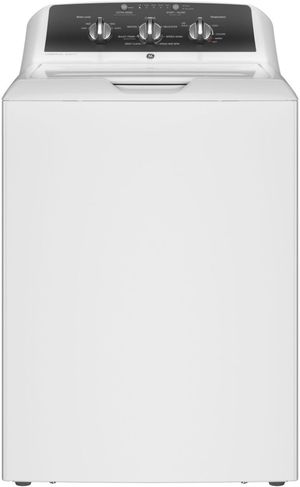
For a household that wants to stop bending over a front load door and still handle a queen comforter at home, this GE lands right at the entry point of the large capacity range. At 4.3 cubic feet it holds roughly 16 to 18 pounds of dry laundry, which covers a full hamper for one to three people in a single pass. The stainless steel basket is the detail worth noticing in Arizona water, since it resists snagging and will not chip the way a coated drum can once mineral scale sets in. Confirm the wash system with our appliance team, because loading technique depends on it.
Top Features
- 4.3 cubic foot capacity: The practical starting line for large capacity, sized for one to three people or a household that runs laundry twice a week.
- Stainless steel basket: No coating to chip and no snagging, which matters over a decade of hard water in the Valley.
- Top loading convenience: Nothing to bend for, no gasket to wipe, and the lid stays open between loads so the drum airs out.
- Straightforward controls: Familiar dials and cycles rather than a touchscreen, which is what a lot of shoppers actually want.
Samsung 4.5 Cu. Ft. Front Load Washer
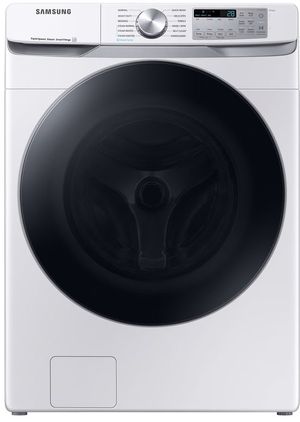
This is the mainstream family answer, and 4.5 cubic feet of front load drum is the capacity where a king comforter finally tumbles instead of slumping. Because the drum has nothing in the middle, that 4.5 cubic feet is all usable, so it holds noticeably more real laundry than a top load model with the same rating. Front load tumbling is also the gentlest wash action of the three designs, which shows up on athletic wear and anything with straps. Wipe the gasket and leave the door ajar between loads, and it stays fresh.
Top Features
- 4.5 cubic foot front load drum: Fully usable volume with no agitator post, sized for a family of three or four.
- Handles a king comforter: Bulky bedding circulates through a shallow wash pool instead of wrapping around anything.
- Gentle tumble action: Nothing rubs fabric against a fixed part, so clothing wears more slowly over hundreds of cycles.
- Stackable footprint: With the correct Samsung stacking kit, this washer and a matching dryer fit a closet where a side-by-side setup never would.
Frigidaire 4.4 Cu. Ft. Classic White Agitator Top Load Washer
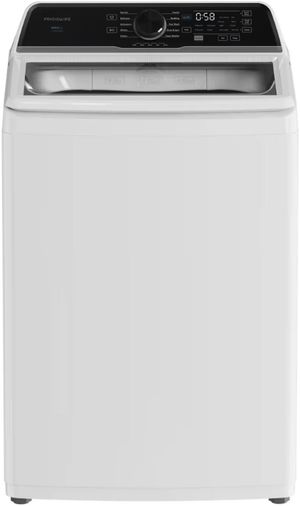
When the laundry is genuinely dirty rather than just worn, mechanical force still wins. This Frigidaire uses a center agitator, which means direct rubbing action on work clothes, yard gear, and kids’ uniforms that came home covered in Arizona dust. The payoff is speed, since agitator cycles typically finish in 35 to 55 minutes rather than the 60 to 90 a low-water cycle needs. Remember the volume trade covered earlier: the post uses drum space, so load in even layers around it and keep everything below the top of the agitator.
Top Features
- Center agitator wash action: Direct mechanical force for heavy soil, which is the fastest way to clean work clothes and sports gear.
- 4.4 cubic foot capacity: Large capacity in a familiar top load cabinet, with a queen comforter well within reach.
- Shorter cycle times: Normal loads finish in roughly 35 to 55 minutes, which keeps laundry day from turning into an all-day project.
- Classic white finish: A clean, neutral look for a garage or utility room laundry area rather than a display finish.
GE 4.6 Cu. Ft. Carbon Graphite ENERGY STAR Front Load Washer UltraFresh Vent System with OdorBlock
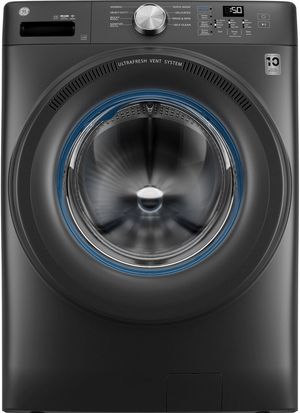
This one answers the single biggest complaint about front load washers before you ever have it. The UltraFresh Vent System with OdorBlock is GE’s built-in answer to gasket odor, which is otherwise the maintenance chore that turns people off front loaders. Pair that with 4.6 cubic feet of fully usable drum and ENERGY STAR certification, and it fits the household that wants low water use and low fuss at the same time. The carbon graphite finish also hides dust better than white in a garage laundry room, which is a small thing until it is not.
Top Features
- UltraFresh Vent System with OdorBlock: GE’s built-in system aimed directly at the gasket odor issue that front load owners complain about most.
- ENERGY STAR certified: Certified efficiency on water and electricity, which compounds across a household running eight or more loads a week.
- 4.6 cubic foot capacity: Comfortably above the king comforter threshold, with all of it usable in a front load drum.
- Carbon graphite finish: A darker finish that hides dust and fingerprints better than white in a garage or mudroom installation.
GE Profile 5.3 Cu. Ft. Sapphire Blue Front Load Washer with UltraFresh Vent System with OdorBlock
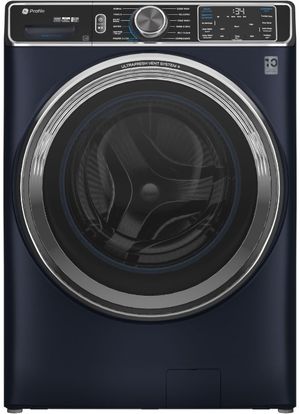
Here is the extra large end of the lineup, and 5.3 cubic feet is where a king comforter and a mattress pad go in together. This is the machine for a family of five or more, a household with a heavy bedding rotation, or anyone whose two-week load count came back above ten. It carries the same UltraFresh Vent System with OdorBlock as the model above, so the largest drum here is also the one with the strongest built-in odor management. The sapphire blue finish suits laundry rooms that are visible from living space rather than hidden behind a door.
Top Features
- 5.3 cubic foot capacity: The extra large tier, handling roughly 22 to 25 pounds of dry laundry per load.
- King comforter plus bedding in one load: Enough room for the bulky rotation that sends most households to a laundromat.
- UltraFresh Vent System with OdorBlock: Built-in odor management on the biggest drum in this group, where residue has the most room to hide.
- GE Profile step-up tier: A more advanced control set and finish than the entry models earlier in this lineup.
- Sapphire blue finish: A finished look for laundry rooms that guests walk past instead of a utility white cabinet.
Our showroom floors carry more washer and dryer sets than this lineup, in every drum style and capacity tier discussed above. Bring your laundry room measurements and our team will match a capacity to the space and to your dryer.
Choosing the Right Large Washing Machine Capacity for Your Home
Capacity is measured in cubic feet of drum volume, most families are well served between 4.5 and 5.0, and drum style, dryer pairing, and laundry room fit decide as much as the number on the tag. The right large washing machine capacity is the one that matches your real weekly load count and the bulkiest item your household washes, not the biggest figure on the sales floor.
Come see the drums side by side. Shop washers and dryers at Spencers TV and Appliance online or visit a showroom in the Phoenix metro to compare a 4.5 cubic foot front load drum against a 5.3 next to it, which is the comparison that settles this decision faster than any spec sheet. Our appliance specialists will ask about household size, laundry room dimensions, and your existing dryer before recommending anything. Our own crews handle delivery, professional installation, hookup, and haul-away of the old machine, and local service and warranty support stay right here in Arizona years after the sale. That is what an independent Arizona retailer gives you instead of a box on a pallet and a phone number.
Read more:
6 Large Capacity Front Load Washers + Before You Buy Guide
6 Best Large Capacity Top Load Washers for Your Laundry Room
Frequently Asked Questions about Large Washing Machine Capacity
A large capacity washing machine generally starts at about 4.3 cubic feet of drum volume, with extra large or mega capacity models beginning around 5.0 cubic feet. Brand marketing language varies widely, so compare the published cubic foot rating rather than the words on the tag, and remember that an agitator model gives up usable space to the center post.
A family of four is well served by a washer in the 4.5 to 5.0 cubic foot range, which handles a full hamper plus towels in one load and washes a king comforter at home. Households with youth sports, pets, or frequent guests should aim at the top of that range or step up to 5.0 and above.
Yes, a king comforter needs roughly 4.5 cubic feet of drum volume to circulate properly, and it moves best at 5.0 cubic feet or more. Front load and impeller drums handle bulky bedding better than agitator models, since a comforter tends to wrap around a center post instead of tumbling.
Not necessarily, because load sensing weighs each load and fills only to match, so a half load in a large drum does not consume a full tub. Per pound of laundry, a full large load is usually more efficient than two smaller loads, though running consistently small loads in a very large drum is the least efficient way to use one.
Yes, dryer capacity should generally run about 1.5 to 2 times the washer capacity so a full wash load can dry in a single cycle. Wet laundry needs room to tumble and airflow to dry, and an undersized dryer forces you to split every large load, which cancels most of the time a bigger washer saves.
Front load washers deliver the most usable capacity per cabinet and handle bulky bedding best, because the drum has no agitator or wash plate taking up space. Top load models with an impeller are the strong middle ground for shoppers who want big-load capacity without bending or maintaining a door gasket.
Why Trust Spencers TV & Appliance?
Since 1973, Spencer’s TV & Appliance has grown to 11 locations throughout the Phoenix Metropolitan Area. The secret to our longevity is simple: personal service. Customer satisfaction has always been the focus of our business, and throughout the years, we have been able to work hard with our suppliers to bring you the best prices. After all, getting customers the best price and personal attention is how we compete with big-box stores, day in and day out.
Not only do we offer top-rated appliances, name-brand electronics, and the best mattresses on the market but we also provide water treatment solutions and perform kitchen design services. Stop by your nearest Spencer’s and see what you’re missing!
Shop Tvs at Spencers
At Spencers TV & Appliance, we provide high-quality, name-brand products at great prices. Your friends in the business are always happy to help you choose the best mattress for lower back and leg pain. Call us, or better yet, stop by at one of our locations in the Phoenix, Scottsdale, and Glendale regions. Visit us today!